


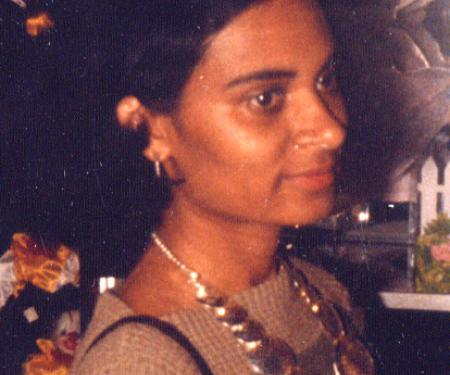
By: Adeel Ajaz Rahi
Mahadai Das was born in 1954 in Eccles, East Bank Demerara, Guyana, and is remembered as one of the pioneering Indo-Caribbean women poets whose voice helped shape Guyanese and Caribbean literature. From her school years at Bishop’s High School in Georgetown, she began writing poetry that reflected both her sensitivity to language and her awareness of social realities. Her academic journey took her from the University of Guyana, where she earned a degree in Philosophy, to Columbia University in New York for her master’s studies, and later to the University of Chicago for doctoral work. Yet her life was marked by hardship: after her mother’s death in 1971, she assumed responsibility for raising nine siblings, a role that profoundly shaped her resilience and sense of duty.
Das was not only a poet but also an activist and cultural worker. In 1976 she volunteered in the Guyana National Service, a program designed to address youth unemployment, and became a member of the Messenger Group, which promoted Indo-Guyanese art forms at a time when they were marginalized. Her political engagement extended to the Working People’s Alliance, where she opposed corruption, racism, and authoritarianism. Beyond activism, she was a dancer, actress, teacher, and even crowned Ms. Dewali in 1971, reflecting her multifaceted personality and commitment to cultural expression.
Her Most Famous Literary Contributions
Among the first Indo-Caribbean women to publish poetry addressing ethnic and gender issues.
Major works:
• I Want to Be a Poetess of My People (1977) – celebrated Guyanese identity and independence.
• My Finer Steel Will Grow (1982) – expressed disillusionment with corruption and inequality.
• Bones (1988) – explored Indo-Caribbean identity in the U.S. and cultural heritage.
• A Leaf in His Ear (2003) – posthumous collection preserving her voice.
The poetry of Mahadai Das is distinguished by its bold engagement with identity, justice, and belonging. At its core, her work affirms Indo-Caribbean heritage, resisting both colonial and postcolonial exclusion, and insisting on the dignity of a community often marginalized in Caribbean narratives. She was equally uncompromising in her critique of gender inequality, exposing the contradiction of men who fought for racial justice yet denied women equality within their own ranks. Her poems gave voice to the struggles of the working class, highlighting the harsh realities of poor labor conditions and exploitation across the Caribbean. Nationalism was another powerful current in her writing, as she called for independence from colonial powers and envisioned a new sense of unity for the region. Alongside these collective concerns, Das explored the intimate tension between cultural heritage and modern urban life, reflecting the personal search for identity in a rapidly changing world. Together, these themes made her poetry both a mirror of her society and a challenge to its injustices.
Tragically, Mahadai Das’s brilliant career was cut short by illness during her doctoral studies in Chicago. Forced to abandon her academic pursuits, she returned to Guyana, withdrew from public life, and published little thereafter. The silence that followed was as heartbreaking as it was undeserved, for hers was a voice that had only begun to reach its full resonance. On April 3, 2003, she passed away in Barbados at the age of 48, leaving behind not only unfinished dreams but also a body of work that continues to echo across the Caribbean. Her passing cast a long shadow over Guyanese letters a silence that felt like the dimming of a flame that had once burned fiercely against injustice and despair. The world lost not merely a poet but a conscience, a spirit whose words had carried the ache of generations and the hope of renewal. In the quiet after her death, her poetry became her pulse, each line a heartbeat that refused to fade.
Her legacy endures as that of a trailblazer who carved space for Indo-Caribbean women in literature, confronting colonial legacies and patriarchal structures with courage and clarity.
THE DAY OF REVOLUTION BY MAHADAI DAS
I dreamt that the day of revolution would come
that thousands would storm the city streets
screaming for justice.
Who can hold back the climbing sun in the sky?
Children hate the trapped darkness of the night.
I heard a cry echo the wind…
Soon the crowd advanced and raised
a further cry.
Like full-blown trees
at their maturing, the schools
surrendered their eager fruits. Then
the Bastille storm advanced upon
the scampering rats
like an irrevocable flood,
like an irrevocable coming of dawn.
Ordered to march, the soldiers, my brothers, came
bearing in the stems of their guns, flowers
for the children of freedom’s
new regiment.
The counterfeit general, left wingless
in the hostile air, clothed in the tarnished
brooches of his vanity, unprepared
for the sudden speech of freedom,
continued to spin his illusions
with the rotten yarn of his life.
Last night
I dreamed that the day of revolution would come.
SOURCE: Poem from her collection My Finer Steel Will Grow