


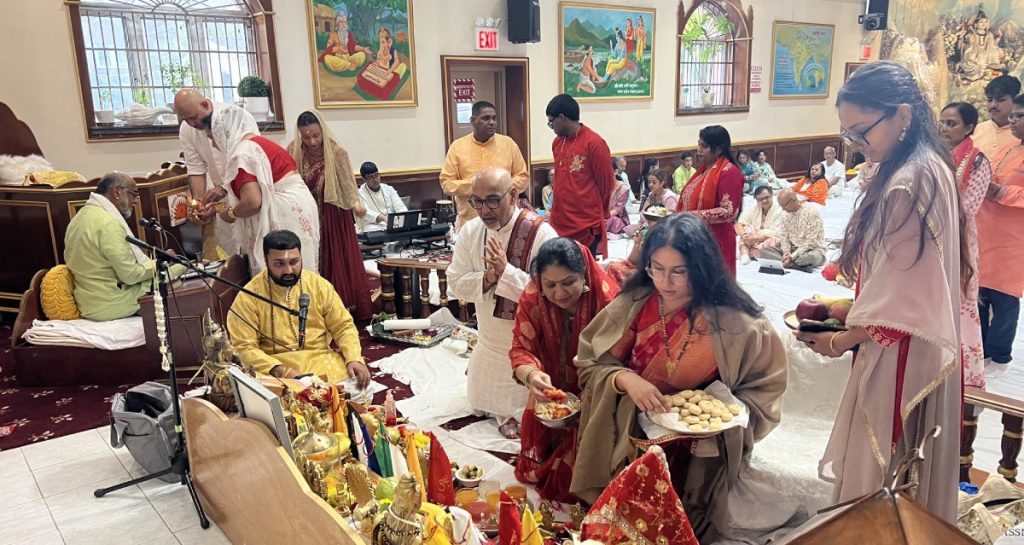
Caribbean American Hindus across the United States are observing Navratri, the sacred nine-night Hindu festival dedicated to the worship of the Divine Mother, Goddess Durga, and her two other manifestations. Caribbean Hindus are concentrated in New York, New Jersey, and Florida with smaller concentrations in other states. They have established temples that tend to observe festivals including the ongoing Navratri celebrations.
The festival has been running from October 11 and concludes on evening of 19. Some mandirs may continue the celebration on the 20th. The festival, like several others, provides an opportunity for Hindu families to renew their spiritual commitments, preserve ancestral traditions and strengthen community bonds. For many Indo-Caribbean families whose roots trace back to Guyana, Trinidad and Tobago, Suriname and other Caribbean territories, Navratri represents more than a religious observance. It is a continuation of a cultural and spiritual heritage that has survived generations of migration, social change and life in a new homeland.
During Navratri, devotees traditionally visit mandirs (Hindu temples), participate in puja (worship), sing devotional songs, listen to discourse (readings, explanation) from sacred texts and seek the blessings of the Divine Mother. Some observe fasting or dietary restrictions, while others devote additional time to prayer, meditation and acts of charity. Worshippers are seen decked out in beautiful traditional outfits – lahenga, shalwar, garrara, kurthas, and the like.
Goddess Durga is revered as a symbol of divine strength, protection and the triumph of good over evil. During this festival, worshippers tend to fast for the entire period, avoiding meat, sex, fish, eggs and maintain cleanliness in the homes for almost two weeks for purity of mind and body to welcome the Lord in their home. As pandits explained, Goddess Durga is the collective manifestation of Brahma (creator), Vishnu (preserver), and Shiva (destroyer). As such, when devotees worship Durga, they are worshipping the other manifestations of God as well. People worship for protection, love and comfort and Goddess Durga offers divine protection and removal of diseases.
The festival also honors the qualities associated with Lakshmi, the goddess of prosperity, and Saraswati, the goddess of knowledge and learning. Three nights each is spent propitiating the three Goddesses. For worshippers, the nine nights offer a period of introspection and spiritual renewal. Devotees seek to overcome negative qualities such as anger, greed, jealousy, lust, selfishness, and hatred while cultivating compassion, humility, discipline, devotion, and helping others..
Like at home, Guyanese and other Caribbean Temples in America have been holding Ramayana sessions or Devi Bhagwatam nightly during this period, and many Hindus have been conducting poojas or yajnas at their home.
Temples throughout the New York metropolitan area have been packed with devotees throughout the observances, including a nightly service presided over by Pandit Rajin Balgobin of New Amsterdam at a massive tent on 132nd Street, off Liberty Ave., in Little Guyana. The festival concludes with the celebration of defeat of Ravan (evil doings) also called victory or Vijay Dashmi.
There are several meanings of Navratri. Nav means nine and ratri means night. It is a festival that is celebrated during the night with prayers and spiritual dancing and a discourse about its meaning that also includes kirtan singing.
During Navratri, devotees normally hold special prayers in the mornings and in the evenings to pay obeisance to the universal mother. They pray to the sun in the morning with jaal (offering specially made liquid called dhar) to burn the evil around society. It is the mother who provides her children with sustenance, and as such, she must be propitiated.
Dhar is a mixture of curd, milk, honey, sugar, neem, cloves, hardi or ground dye, tills, and other sweet spices to appease the God to offer bliss over humanity. This tradition is a continuation of the practice inherited from Hindu ancestors who came from India between 1838 to 1917 as indentured labourers or girmitiyas.
Guyanese and other Caribbean Hindus continue the tradition of observing Navratri and other festivals in New York, New Jersey, Florida, Minnesota, Georgia, Texas and other places where they have settled. Other Caribbean Hindus joined Guyanese in observing the Navratri festival that commenced after the end of the two- week festival of Pitri Paksh.
Guyanese and Trinis have helped to institutionalise Navratri and other Hindu as well as Islamic festivals in parts of America. They receive support and recognition from politicians. With regards to Navratri, the celebration included making offerings in the morning and evening over the nine days. The observance was extended into the Dussehra celebration on October 11 to 19; Dussehra means tenth day. Dussehra symbolises the conquest of good over evil. All temples in the NY area held discourses on the occasion – some nightly discourses.
Navratri is one of the holiest periods in the Hindu calendar that was accompanied with people fasting, visiting mandirs, and performing pujas as well as inviting pandits to conduct special services at their home. People fasted during this period focussing on purification of the minds and bodies. During this period, people tend to pray with great fervour and devotion. Devotees were seen nightly dressed in traditional colourful garb heading for the mandirs; there are dozens of mandirs in the greater Richmond Hill area. In New York, all of the temples held Navratri kathas and poojas. The pandits explained that Navratri is an extremely wonderful festival highly inspiring and instructive on how people should live.
Navratri which is directly linked to other Hindu festivals like Ram Leela, that will be celebrated right after Navratri which will be followed by Diwali and then Karthik or Teerat that concludes the year for religious festivals. The famed Lord Rama is also associated with Navratri — his appearance, disappearance and reappearance in the holy city of Ayodha in the Fall. In the spring Navratri, Hindus celebrate the birth of Lord Rama, and in the fall, Hindus celebrate the destruction of the evil Ravana by Lord Rama, signifying the triumph of good over evil which is also called Dussehra, a holiday in India. The Ramleela celebrations are associated with this period and some temples and Hindu organizations will hold such celebrations.
For more picture click here:
https://www.facebook.com/share/p/1JHUP7SuGK/