


Book Review by Shashi Dookhan
From ‘Coolie’ to Elite: A Powerful Poetic Chronicle of the Girmit Legacy
Although a person’s introduction may begin with their face, their true identity is ultimately shaped by their words, thoughts, and deeds. One such remarkable personality is Dr. Deepti Aggarwal, whom I have had the pleasure of meeting personally. While she is warm and approachable in person, it is her scholarly work and meaningful contributions that have established her strong identity.
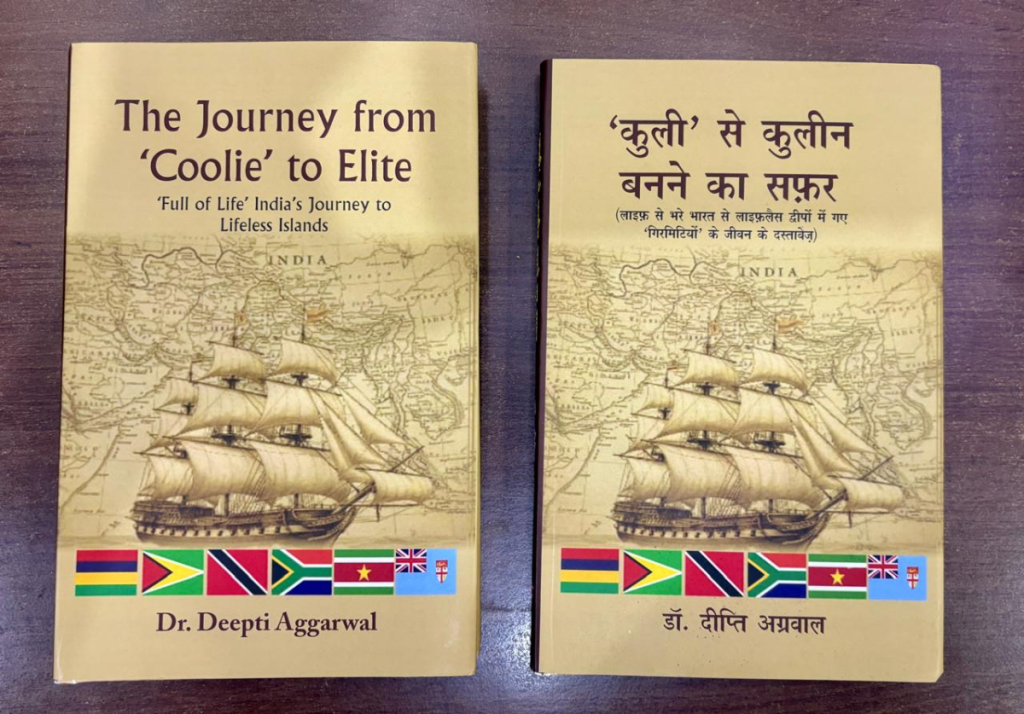
Recently, I ordered and read her book From ‘Coolie’ to Elite through Amazon. This book is far more than a collection of poems; it is a sensitive and well-researched literary document of the Girmit experience. After reading it, I simply could not resist writing about it.
Let us first know more about the author and her remarkable work.
Every individual dreams of achieving something meaningful and strives tirelessly to turn those dreams into reality. Dr. Deepti Aggarwal’s journey is a perfect example of this determination. At nearly fifty years of age, she resolved to redefine herself by pursuing a Ph.D.—a decision that was, in itself, a formidable challenge. Choosing an appropriate research topic proved equally demanding. Yet, as the saying goes, “Where there is a will, there is a way.” With unwavering perseverance, the support of her husband, and the guidance of her mentors, she not only earned her doctoral degree but also produced numerous research papers and, as a significant outcome of her scholarly journey, this remarkable book, From ‘Coolie’ to Elite.
Dr. Deepti Aggarwal’s work represents a significant contribution to the field of Indian Diaspora Studies, particularly to the history of indentured labour. Between 1834 and 1920, millions of Indian labourers were deceived, coerced, or lured into signing indenture agreements and transported to colonies such as Mauritius, Guyana, Trinidad, Fiji, Suriname, and South Africa. Through sixty poems accompanied by vivid illustrations, this book narrates their struggles, exploitation, resilience, preservation of cultural heritage, and eventual journey toward dignity and success.
In the author’s own words:
“This book is a heartfelt tribute to our Girmit ancestors and a humble effort to preserve their legacy for future generations.”
The cover page itself transports readers to colonial India, depicting sailing ships that carried thousands of Indians across the seas to six distant lands. The opening poem, “We Are One,” beautifully brings together the Indian philosophy of Vasudhaiva Kutumbakam (the world is one family), the African concept of Ubuntu, and Suriname’s Bromki Dyari, all of which celebrate love, compassion, and universal brotherhood.
The book is divided into fifteen thematic sections, tracing the complete journey from the dreaded “Kala Pani” (the Black Waters) to the transformation from “Coolie” to “Elite.” Dr. Aggarwal uses poetry not merely as a literary expression but as a powerful medium of historical documentation.
Her methodology may aptly be described as “poetic historiography,” where literature becomes a means of recording historical trauma often overlooked or silenced in conventional colonial archives. This approach aligns closely with contemporary scholarship in Memory Studies and Trauma Studies.
The author’s extensive field research further strengthens the credibility of her work. Her visits to the British Library and SOAS in London, as well as to Trinidad, Guyana, Suriname, and Mauritius, demonstrate meticulous scholarly preparation. By integrating archival research, oral histories, museum collections, and documentary evidence into her poetic narrative, she presents an interdisciplinary interpretation that is both academically sound and emotionally compelling. This makes the book valuable not only for general readers but also for students and researchers interested in diaspora studies, history, literature, and cultural heritage.
Perhaps the book’s most significant contribution is that it restores the voices of those who were systematically marginalized within official colonial records. Dr. Aggarwal also cites abolitionist John Scoble (1838–1840), who described the indenture system as “a new form of the slave trade founded upon the forcible abduction of unsuspecting and innocent Hindus.” Such historical references reinforce the authenticity of the narrative and highlight the exploitative nature of the indenture system.
The author’s objective extends beyond documenting history. She seeks to introduce younger generations to the hardships, poverty, helplessness, resilience, and extraordinary courage of the Girmit labourers, whose sacrifices are gradually fading from public memory. Through this work, she encourages readers to draw inspiration from their lives while exposing the hidden history that followed the official abolition of slavery. It reminds us how, between 1834 and 1920, the British Empire continued exploiting Indian labour through the indenture system by transporting them to colonies such as Mauritius, Guyana, Trinidad, South Africa, Suriname, and Fiji.
Dr. Aggarwal’s poetic collection touches upon nearly every major dimension of the Girmit experience. For instance, the section “The Voyage Across the Black Waters” vividly portrays the three-month sea journey, the symbolic Jahaji Bundle, and the unique bonds of Jahaji Brothers and Jahaji Sisters that emerged among strangers who became family.
A glimpse from her poem “The Jahaji Bundle” reads:
On the long, unknown sea journey
Across the ‘Kala pani’
They carried a smalaa bundle
the bundle that came to be calaed
“The Jahaji Bundle.”
Similarly, in ” Jahaji bhai, and Jahaji bahan,” she writes:
Crying and sobbing,
they all became
Jahaji bhai, and Jahaji bahan .
There had only one caste,
only one religio-‘roti’
They need for a full meal,
These verses beautifully illustrate how suffering dissolved social barriers and transformed strangers into one family. They capture not only the emotional realities of the indenture voyage but also the birth of a new shared identity that would shape the Indian diaspora for generations.
One of the book’s most remarkable achievements is its attempt to recover almost every forgotten dimension of the history of indenture. Dr. Aggarwal does not limit herself to the familiar narratives of plantation labour; rather, she brings to light those marginalized experiences that have often remained absent from mainstream histories.
For example, her poem “Hill Coolie” gives voice to the indigenous tribal labourers who were among the earliest indentured workers to arrive in Mauritius. Despite their pioneering role, they remain largely invisible in conventional histories of indenture. By foregrounding their experiences, the author makes an important contribution to both Diaspora Studies and Indigenous History.
Likewise, her poetic portrayals of Aapravasi Ghat in Mauritius and Nelson Island in Trinidad recreate, with haunting realism, the atmosphere of those historic immigration depots. Readers can almost visualize the fear, uncertainty, and despair experienced by the labourers upon their arrival, making these poems emotionally powerful as well as historically informative.
The third section of the book presents an unflinching account of the exploitation and injustice suffered by indentured labourers. It portrays a system in which workers were subjected to inhumane treatment while the colonial administration often remained silent spectators. The poems repeatedly remind readers that, across the world, poverty has too often determined a person’s worth, leaving the poor with little dignity in either life or death.
A poignant example is the poem “The Death of a Poor Man,” based on the tragic death of the indentured labourer Karunapillai, who died after being brutally assaulted by a European overseer and thrown into a drum. His death symbolizes the utter disposability of poor labourers under colonial rule.
A few translated lines read:
Died right inside the drum.
And how else would he die?
If not like this, then some other way,.
what difference does it make for a poor person
Are there a hundred-fifty ways to die.
These verses capture the devastating reality that the lives of indentured labourers were considered expendable, their deaths scarcely acknowledged by those in power.
Giving Voice to Girmit Women
One of the book’s greatest strengths lies in its sustained attention to the experiences of indentured women.
The number of women recruited under the indenture system was significantly lower than that of men. Historical records indicate that among the ships carrying indentured labourers to South Africa, approximately 62 percent of the passengers were men, only 25 percent were women, while the remainder were children. From the very beginning, women were regarded as little more than “cargo,” occupying the lowest position within the colonial labour hierarchy.
Yet despite enduring unimaginable hardship, sexual violence, discrimination, and exploitation, Girmit women played an equally significant role in building prosperous societies across the diaspora. Recognizing this overlooked contribution, Dr. Aggarwal dedicates four of the book’s fifteen sections exclusively to the lives of indentured women.
Poems such as “Postcard,” “The Vulture,” and “Mother, Please Speak,” along with biographical poems on Kunti, Jan Tetary, and Sujaria, document the gendered violence experienced by these women while simultaneously celebrating their courage, resilience, and resistance.
Reading these poems is deeply unsettling. They reveal the physical, emotional, and psychological suffering endured by countless women whose stories have remained buried beneath official histories. Yet these women refused to surrender. They persisted, resisted, and rebuilt their lives with extraordinary determination.
The author portrays them as symbols of strength, perseverance, and dignity. Whether it is Sujaria, Narayani, Kunti, Jan Tetary, or Parvati—the wife of Soma Naidu—each woman’s life becomes a source of inspiration, conveying profound lessons of courage and endurance.
One poem dedicated to these women reads:
Gold spinner ,
The pen and ink of Saraswati,
The art of living,
The principle of karma.
They broke the social chains,
The held the rope of struggle.
They did not loose —
They kept fighting,
They wrote the history.
Equally powerful is the poem “Adi Shakti: Coolie Woman,” in which the collective voice of Girmit women speaks across generations:
Yes, I am a Girmit woman,
The symbol of struggle and strength
I fed my children
With my blood and my milk.
I gave them values and learning
But the mute histories
mention nothing
of my labour
or of my suffering.
I am Durga.
I am Adi Shakti.
The half sky
of the Girmit world .
These verses reclaim the dignity of women whose sacrifices have long remained unacknowledged in official historical narratives.
Remembering Those Lost at Sea
Another notable contribution of the book is its documentation of maritime tragedies associated with the indenture system.
The eighth section memorializes shipwrecks such as the Syria, Sunderingham, and Sooonens, preserving the memories of hundreds of anonymous labourers who perished at sea—individuals who received neither proper funerals nor historical recognition.
In the poem “Salvation ,” Dr. Aggarwal commemorates these forgotten souls:
In Natal
sank the The French ship Sooonens,
going to Saint Martinique
There were 376 Coolies on board
168 were found
No one gave them a shoulder
No one came
to light the funeral fire
No one shed two tears
No one came
To read the ‘Fatiha’.
The poem mourns not only the loss of life but also the absence of ritual, remembrance, and familial farewell. It restores humanity to those whose deaths disappeared into the vastness of the ocean without ceremony or memorial.
Dr. Aggarwal’s work demonstrates that poetry can become an archive of memory. Through these narratives, she restores dignity to forgotten lives, transforms silence into testimony, and preserves histories that conventional archives have often neglected.
Beyond recording suffering and injustice, From ‘Coolie’ to Elite is also a moving account of cultural survival. Dr. Deepti Aggarwal demonstrates how Indian indentured labourers, despite enduring extraordinary hardships, succeeded in preserving their religion, language, traditions, and identity in unfamiliar lands.
When these labourers first stepped onto distant shores, they could scarcely have imagined the length and darkness of the journey that lay ahead. Their hopes of returning home gradually faded as years of exploitation, isolation, and uncertainty unfolded before them. They could neither turn back nor easily move forward.
In these circumstances, the small Jahaji Bundle they had carried from India became far more than a bundle of personal belongings. It became a repository of memory, faith, and identity. Sacred texts, devotional books, seeds, and cherished objects connected them emotionally to the homeland they had left behind.
For many, the Ramcharitmanas became a source of immense spiritual strength. It offered comfort during moments of despair and gave them the resilience to endure unimaginable suffering.
The author poignantly captures this emotional bond in her poem “Girmit and the Ramcharitmanas”:
In the ‘baithka’ beneath a dim oil lamp,
After a round of task, they read verses of the Ramayana.
Those sacred lines brought solace to their hearts,healed
their wounds
Rama also went to the forest with Sita
They believed they too would return to India someday,
Just as he returned to Ayodhya.”
These lines beautifully illustrate how literature became both spiritual refuge and psychological resistance. Faith helped the labourers survive not merely physically but emotionally as well.
Preserving Language and Cultural Identity
Dr. Aggarwal reminds readers that although indentured Indians were dispersed across different colonies—with distinct geographical, political, and social conditions—their suffering remained remarkably similar. What united them was their unwavering determination to preserve their language, religion, customs, and cultural heritage.
While adapting to new environments, they refused to sever their connection with India. This delicate balance between adaptation and cultural continuity forms one of the central themes of the book.
Through her poems and illustrations, the author vividly introduces readers—especially younger generations—to the everyday life of Girmit communities. As they progress through the collection, readers encounter traditional clothing, ornaments, household utensils, grinding stones, earthen stoves, farming implements, tattooing traditions, culinary practices, and countless other aspects of material culture that have gradually disappeared from everyday life.
This visual and poetic reconstruction of the Girmit world is one of the book’s most distinctive creative achievements.
The Journey of Hindi Across the Oceans
Language occupies a particularly important place in the book.
Through the poem “Mother Hindi,” Dr. Aggarwal traces the remarkable transformation of Hindi after its migration across the seas. Readers are introduced not only to standard Hindi but also to its vibrant diasporic forms—including Fiji Hindi, Sarnami Hindi, Natal Hindi, and other overseas linguistic traditions that evolved through interaction with local languages and colonial societies.
Rather than treating these varieties as imperfect versions of Hindi, the author celebrates them as living expressions of cultural resilience and linguistic creativity.
Likewise, the book explores the evolution of traditional music and performing arts within the Indian diaspora. Folk traditions such as Chowtal, Alha, Bidesia, and the modern development of Chutney Music are woven naturally into the poems and illustrations, demonstrating how culture continued to evolve while remaining deeply rooted in Indian traditions.
The book thus becomes not merely a literary work but also an archive of diasporic cultural history.
A Living History of the Girmit Experience
Dr. Aggarwal herself emphasizes that this volume is not simply a collection of poems. Rather, it is an open book of countless Girmit lives—a living memorial to generations of ancestors whose sacrifices transformed distant lands.
Although the indentured labourers never discovered the mythical “land where gold could be picked up like stones,” they achieved something even more remarkable. Through their relentless hard work, discipline, and perseverance, they transformed the lands they settled into prosperous societies.
As the author suggests, wherever they went, they cultivated not only the soil but also hope, dignity, and civilization.
Documenting Colonial Violence
Another important contribution of the book is its careful documentation of colonial recruitment practices and systemic violence.
The author discusses the role of the Arkatis (recruitment agents), whose deceptive methods lured countless unsuspecting Indians into signing indenture contracts. She also addresses documented instances of medical abuse, including violence committed under the guise of healthcare—such as the well-known case involving Dr. Houlman aboard the ship Aizal.
Similarly, judicial injustice receives careful attention through historical episodes such as the Narayani Case, exposing how colonial legal systems often denied justice to indentured labourers.
One particularly thought-provoking poem extends Mahatma Gandhi’s famous metaphor of the “Three Wise Monkeys.” Dr. Aggarwal introduces a symbolic “Fourth Monkey”—representing those who deliberately refused to record, acknowledge, or preserve the atrocities committed against indentured labourers.
This powerful metaphor reminds readers that silence itself can become a form of historical violence.
Likewise, her poem “Cattle Fair” compares the recruitment of indentured labourers to the auctioning of livestock, echoing Hugh Tinker’s influential description of the indenture system as “a new system of slavery.”
Throughout these chapters, Dr. Aggarwal successfully demonstrates that poetry can perform the work of history. Rather than merely describing events, her poems preserve memory, restore dignity, and challenge historical silence.
(Conclusion)
To enhance the reader’s understanding, Dr. Aggarwal has thoughtfully included illustrated explanations of difficult historical and cultural terms throughout the book. This feature makes the work especially accessible to students and general readers encountering the history of indenture for the first time.
Equally impressive is the extensive bibliography provided at the end of the volume, which reflects the depth and rigor of the author’s research. Her scholarship extends beyond commonly cited sources to include several rare Hindi publications that have received little attention in mainstream diaspora studies. Among these are Lal Bihari’s Damra Faag Bahar, the Presbyterian Church Hymnal, Pratap Chandra Sharma’s Pratapanjali, and Chowtal Rang Bahar compiled by Ramnaren Sees Naren. She also refers to Hindosthani Kohinoor, recognized as one of the earliest Hindi newspapers published overseas. By recovering these neglected materials, Dr. Aggarwal significantly enriches the documentary foundation of Girmit studies.
The author’s multidisciplinary approach accommodates diverse learning styles and makes this work an invaluable resource not only for literary scholars but also for museum exhibitions, educational curricula, public history initiatives, and cultural heritage projects.
Dr. Aggarwal candidly acknowledges an inherent limitation of historical writing when she observes that “only those who have personally endured an experience can fully express its reality.” Nevertheless, her extensive engagement with descendant communities, meticulous archival research, incorporation of oral histories, and collaborative exhibitions demonstrate both scholarly integrity and a profound emotional commitment to preserving Girmit heritage.
The international recognition that her work has received—including appreciation from High Commissioners, diplomats, community leaders, scholars, and members of the global Indian diaspora—attests to its significance. The demand for the Hindi edition abroad and its subsequent English translation, The Journey from ‘Coolie’ to Elite, translated by Pawan Shah at the request of international readers, further underscores the universal relevance and appeal of this remarkable work.
One of the book’s greatest strengths lies in the harmonious balance the author achieves between intellectual scholarship and emotional sensitivity. She presents an academically rigorous subject with remarkable artistic elegance and readability. Because she writes with sincerity and creative freedom, the poems possess both authenticity and emotional depth.
The language itself deserves special appreciation. Dr. Aggarwal skillfully weaves together Hindi with words and expressions drawn from Urdu, Bhojpuri, English, Dutch, Swahili, and several diaspora languages. These multilingual elements enrich the poems and faithfully represent the linguistic diversity that emerged within indentured communities. Certain transformed words and hybrid expressions themselves become symbols of the creativity and adaptability of displaced peoples.
Without resorting to artificial complexity or ornamental excess, the author employs a language that is graceful, expressive, and accessible. Her poetic craftsmanship is evident throughout the collection, where historical documentation and literary beauty complement one another seamlessly.
From both scholarly and creative perspectives, From ‘Coolie’ to Elite represents a landmark contribution. It demonstrates the extraordinary capacity of poetry to function as historical documentation while simultaneously strengthening the relationship between literature and history. Particularly commendable is the author’s practice of identifying the historical inspiration or documentary source behind each poem, thereby reinforcing the academic credibility of the collection. Her inclusion of Hindi maps of the Girmit countries further enhances the book’s educational value, making it especially useful for students and researchers.
In my opinion, this important work deserves to be included in the curricula of universities and centres devoted to Hindi literature, Diaspora Studies, South Asian History, Comparative Slavery Studies, Gender Studies, and Postcolonial Studies. It has the potential to become an indispensable teaching resource across multiple disciplines.
In conclusion, Dr. Deepti Aggarwal’s work represents a significant scholarly achievement and may justifiably be regarded as a valuable primary resource for the historical study of the Girmit experience. At the same time, it expands the global horizons of Hindi literature by bringing an often-overlooked chapter of history to a wider international audience.
Originally published in Hindi and now available in English, the book is also accessible through Amazon. I warmly encourage all readers who wish to understand the history of indenture in a compelling, engaging, and deeply human manner to read this remarkable volume.
Ultimately, the book succeeds in fulfilling its stated purpose:
“This book is a heartfelt tribute to our Girmit ancestors and a humble effort to preserve their invaluable legacy.”
It is a lasting source of inspiration for future generations, while its rich historical content makes it an invaluable resource for scholars and researchers alike.
I extend my heartfelt congratulations and best wishes to Dr. Deepti Aggarwal. May her research continue to flourish, and may her pen continue to enrich Hindi literature for many years to come.
I conclude with these lines, dedicated to her work:
If success is a beautiful flower,
Humility is its fragrance.
Achieve all that you aspire to in life,
But always remember this:
Let the path to your destination
Pass through the hearts of people.
Jai Mauritius! Jai Hindi! Jai Bharat!
— Shashi Dookhan
Former Radio Production Manager
Mauritius
Facebook Comments Box