


Guyana’s Human Capital Paradox: Investing More, Returning Less(forthcoming), by economist Ramesh Gampat and graduate researcher Minakshi Mahabir, is a serious, data-rich, and urgently relevant contribution to the national conversation about development in the age of oil. Its central argument is straightforward but powerful: Guyana is now spending far more on health and education, yet the measurable returns to that spending remain weaker than the scale of investment should produce. At a moment when public debate is often dazzled by headline GDP growth, new infrastructure, and the symbolism of oil wealth, this book asks a more consequential question: are Guyanese lives, capabilities, and opportunities improving commensurately?
The authors’ greatest achievement is to shift attention from expenditure to outcomes. In resource-rich societies, governments often equate spending with progress: a larger budget, a new school, a hospital expansion, or a scholarship programme is presented as proof of development. Gampat and Mahabir resist that temptation. They insist that public investment must be judged not by its announcement value but by its conversion into healthier people, better learning, higher productivity, and broader opportunity. This distinction gives the book both analytical clarity and public importance.
The book is strongest when it develops its investment-returns paradox through comparative evidence. Using Guyana’s budget data and international indicators such as the Human Development Index and the Human Capital Index, the authors show that Guyana’s relative spending effort compares favourably with many peer and aspirational countries, while its health and education outcomes lag behind. The formulation of the “64/80 ratio” is especially memorable: Guyana invests more than a majority of comparator countries, but most of those countries achieve better returns. As a summary device, it is elegant, accessible, and difficult to ignore.
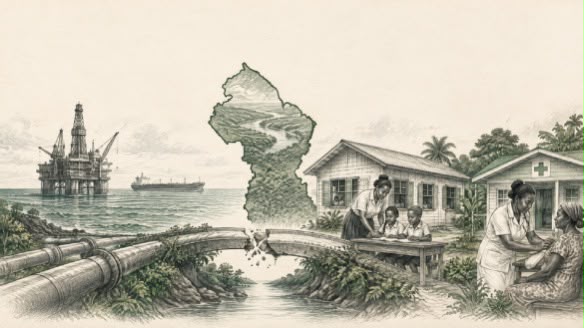
Another strength is the authors’ refusal to let oil income obscure the lived economy of most citizens. The non-oil adjustment to Guyana’s HDI is one of the book’s most useful analytical moves. By distinguishing between the overall economy and the non-oil economy, the study exposes the risk that petroleum-driven GDP can create an inflated image of human development. The reader is reminded that national income is not the same as household welfare, and that an oil enclave can coexist with weak schools, strained health systems, labourshortages, and persistent inequality.

The policy chapters are also valuable because they avoid fatalism. The diagnosis is sober but not despairing. The authors argue that Guyana has both the revenues and the knowledge required to act. Their emphasis on teacher quality, technical and vocational education, health system strengthening, anti-corruption oversight, data systems, and alignment between education and economic strategy gives the book a practical orientation. Readers may disagree with particular policy preferences, but the overarching message is persuasive: Guyana must become better at converting money into capability.
There are, however, areas where the manuscript could be strengthened. First, the prose is sometimes forceful to the point of overstatement. Phrases that describe political actors or institutions in sharply accusatory terms may appeal to readers already sympathetic to the argument, but they may also make skeptical readers less receptive to the evidence. The book’s data are strong enough to carry the criticism; in some places, a slightly cooler tone would give the argument even greater authority.
Second, because the manuscript is ambitious and wide-ranging, it naturally returns to several of its core themes—especially the contrast between spending and outcomes, the dangers of corruption, and the inadequacy of GDP as a welfare measure. In a book of this scope, such recurrence helps reinforce the central argument. A little more signposting in a few places could further help readers see how each return to these themes adds a new layer to the analysis.
Third, while the authors are careful to describe the HDI and HCI as proxy measures, the causal interpretation of the evidence could be handled with even greater caution. The book convincingly shows that Guyana spends relatively more while achieving relatively weaker outcomes, but the precise causes of that gap are difficult to isolate. Historical underinvestment, migration, geography, weak implementation, procurement problems, teacher quality, health-system staffing, and labour-market structure may all matter. The manuscript acknowledges these complexities, but readers would benefit from an even more explicit framework separating correlation, diagnosis, and causation.
These observations are offered in the spirit of refinement rather than objection, and they do not weaken the book’s central contribution. Indeed, they point mostly to matters of emphasis, framing, and presentation rather than substance. Guyana’s Human Capital Paradoxsucceeds because it poses the right question at the right time. It reminds readers that oil wealth is temporary, but human capability is cumulative; that expenditure is not achievement; and that development cannot be measured by GDP alone. Its core warning is timely: Guyana’s current prosperity will matter historically only if it is converted into healthier children, better-trained workers, stronger institutions, and more inclusive opportunities.
For scholars, policymakers, students, and concerned citizens, this is a book worth reading. It is empirical without being narrowly technical, critical without being defeatist, and national in focus while speaking to a wider problem faced by resource-rich societies everywhere. Above all, it insists that the measure of Guyana’s oil era will not be the size of its budgets or the speed of its GDP growth, but the quality of life and productive capacity of its people. That is the right standard, and this book makes a compelling case for applying it now.