


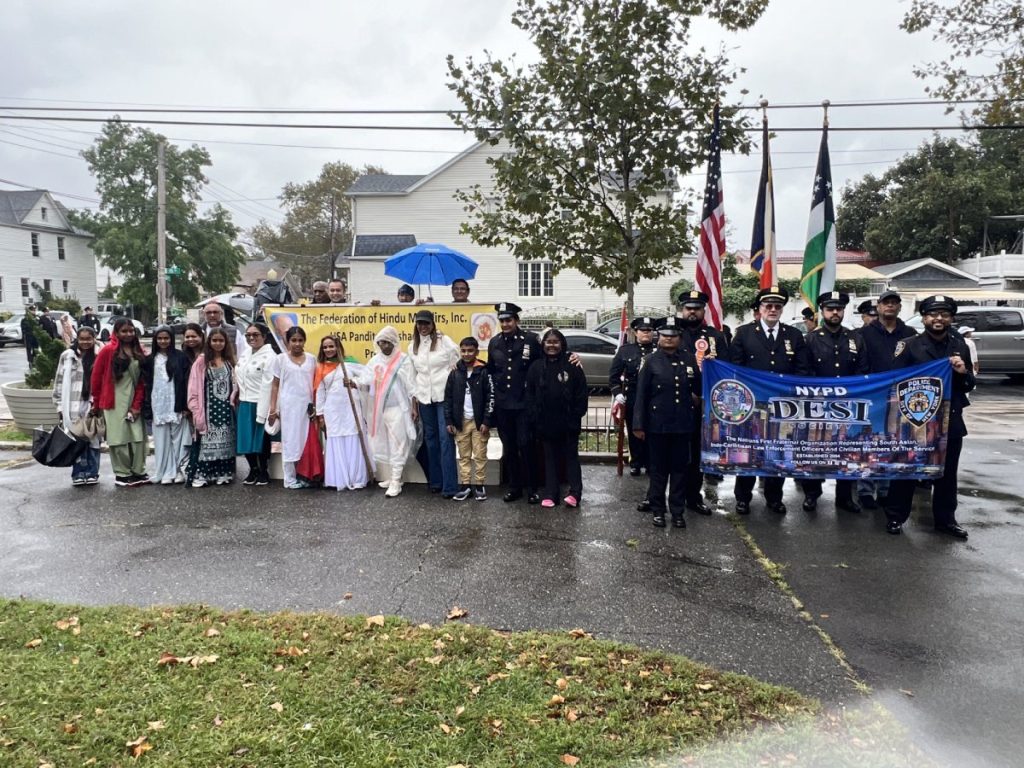
A quiet peace march in Little Guyana, Little Trinidad in the heart of Richmond Hill brought together members of the community to celebrate the timeless teachings of the peace icon Mahatma Gandhi.
The march and its culmination at Smokey Park last Sunday rainy afternoon, on the occasion of the 157th Gandhi Jayanti, or birth anniversary of Mohandas Karamchand Gandhi, paid tribute to Mahatma (meaning noble soul as he is called) Gandhi with music, bhajans, and speeches. Gandhi was born on October 2, a national holiday in India granted after independence, and is regarded as the father of the Indian nation which was became a nation on August 15, 1947.
The march, from 120th Street and Liberty Avenue to 125th Street and 95th Ave., in Little Guyana and Little Trinidad and Little Punjab, was led by flag (America, Police, India, and others) bearers and a tassa band. Others also carried the flag of Guyana and Trinidad. Onlookers in the rain cheered the marchers who were escorted by the police. People came out to see what the march was about. There were street closures to facilitate the parade of Indo-Caribbean New Yorkers, India nationals, and others. Participants gathered to honour the life and legacy of the great Indian leader, whose message of truth, tolerance and peaceful resistance continues to inspire generations. The event provided an opportunity to commemorate the life and philosophy of Mahatma Gandhi while celebrating the diverse heritage of the neighborhood and reinforcing the importance of peaceful coexistence. The event also served as an opportunity to remind younger generations about Gandhi’s historic contribution to the struggle for justice through non-violent means. His philosophy of Satyagraha — the pursuit of truth through non-violence — has influenced social and political movements across the world.
The march has particular significance in Richmond Hill, a community with deep Indo-Caribbean roots. Generations of residents have maintained strong cultural, religious and family connections to India as well as to Guyana, Trinidad and Tobago and other parts of the Caribbean. For many families, Gandhi represents a link between these histories. Indian culture was carried to the Caribbean by generations of migrants and became an integral part of the region’s social and cultural identity. Gandhi championed an end to indentureship that was abolished on January 1, 1920. Indo-Caribbeans migrated to and established themselves in Queens and other parts of NY, bringing their traditions, faiths, languages, music and customs with them.
The Gandhi Peace March reflects that continuing journey.
It was the 31st annual Gandhi Peace March, honoring the enduring legacy of one of the world’s most influential advocates of peaceful change. Pandit Baya of Black Bush and Port Mourant led the procession as Gandhi for the mile-long journey followed by others. Pt. Baya played this role for several years.
The program at the park was chaired by pandit Dr. Sanjay Ramkissoon, a respected physician and community figure who has been involved in activities promoting Indo-Caribbean culture and community engagement. Dr Ramkissoon is affiliated with the Shri Surya Narayan Mandir in addition to the Federation of Hindu Mandirs and USA Pandits Parishad. He has participated in initiatives involving the Guyanese and wider Indo-Caribbean diaspora in USA, particularly in NY and Florida as well as in Guyana. He and other speakers highlighted the importance of Gandhi’s philosophy at a time when there are devastating wars (Iran, Ukraine, elsewhere) and when communities around the world continue to face division, conflict and social challenges.
A police officer sang the USA national anthem while Indo-Caribbean youths sang the Indian national anthem. Pt Haris Umadas delivered the feature address. Also speaking was Prem Narine of NY Police. Speakers also reflected on Covid 19 that took countless lives including hundreds from the Indo Caribbean and South Asian communities.
The march was undertaken to recognise the work of the iconic Gandhi and to spread awareness of his teachings of non-violence and peace. Gandhi is known as the Apostle of Peace the world over for his unwavering belief in non-violence (Ahimsa). He used ahimsa on non-cooperation to gain India’s ‘Swaraj’ (self-governance) and independence.
Gandhi was born on Oct 2, 1869 in Porbandar, Gujarat. He studied law. He traveled to Durban, South Africa to represent an Indian company in conflict with the state. While there, he witnessed the mistreatment, racism, and persecution of indentured Indians and their descendants by the White colonialists. Gandhi spoke out against the injustice meted out to Indians and Africans. He was physically brutalized by the White rulers.
Accomplishing his goal in South Africa, Gandhi decided to return to India, arriving on January 9, 1915 in Bombay (now Mumbai), a day celebrated as Pravasi Bharat Divas in which overseas Indians are honored by the Indian government. Gandhi joined the movement against British rule in India, living a simple, austere life.
Gandhi led the non-violent resistance against British rule in India and was at the forefront of the nation’s freedom struggle. He was often beaten or imprisoned for his resistance to British injustice.
His birth anniversary is usually marked across the globe including at the UN as the International Day of Non-Violence. The New York Peace March was organised as usual by the Indo-Caribbean Federation of Hindu Mandirs Inc., and the USA Pandits Parishad. The organisation is led by former Berbician pandit, Dharamacharya Pt. Ram Hardowar Panday.
Dr. Ramkissoon and other speakers emphasized that Gandhi’s message extends far beyond history. The principles of peace, compassion, justice and respect for others remain essential to building stronger families and communities. The program at the park featured cultural displays, speeches and community participation, creating an atmosphere of solidarity and reflection. Families, elders, young people and community leaders joined in demonstrating their commitment to peaceful coexistence.
Dr Ramkissoon saluted the work of the executives of the two organizations, Pt. Baya, and several mandirs for putting together the march and program — President of FOHM Pt Gurdatt Jagnanan, President USA Pandit’s Parishad Pt Bhola Adinarayan Sharma, Vote of thanks
Doodnauth Dasrat, 2nd VP of the FOHM and several others from various mandirs as well as officers from the police department.
At the conclusion of the program, attendees gathered around a tree that was planted during Covid five years. Floral tributes were made on the tree and to Gandhi ji.
The Gandhi Peace march was initiated by prominent community advocate and executive member of Tri-Murthi Mandir, Dr. Dhanpaul Narine some 31 years ago.
For more picture click here,
https://www.facebook.com/share/p/1FKTqgYwyi/