









Engagements with Guyanese (and Trinidadians) in USA find that they are overwhelmingly supportive of President Trump’s military intervention in Venezuela to oust dictator Nicolas Maduro. Most Guyanese Americans live in the greater New York area and in Florida. They are pleased that the tyrant has been captured and deposed and has been brought to USA to face justice; Maduro had been an incompetent tyrant who inflicted suffering on his people. It is noted that some half Guyanese Americans, mostly Indians, supported Trump in the 2024 election. Guyanese have been very thankful that USA has protected Guyana from the threats issued by Maduro. President Trump administration issued a stern warning to Maduro to keep his hands off Guyana and the operations of ExxonMobil. Guyanese are not thinking about principles and rules of international law and plundering of resources. They are just pleased that the Americans got rid of this horrible thug ruling a country on Guyana‘s border and threatening to take over two thirds of its neighbor’s territory. The protection and security of Guyana’s border is their primary concern.
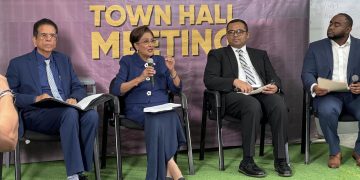
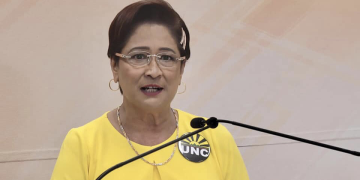
Maduro had led the United Socialist Party, and has been in power since 2013 when his mentor, Chavez died. He repressed the opposition and silenced dissent, at times with the use of violence. Some (leftist) Guyanese condemn the military intervention saying it violates international law. Maduro had threatened seizure of two thirds of Guyana which is also a violation of international law. And he also threatened neighboring Trinidad and Tobago and the Prime Minister Kamla Persad Bissessar who has been very critical of his governance since she became PM last May. The governments of Guyana and T&T have been supportive of President Trump’s military actions against Maduro to disrupt drug trafficking. They have also supported measures to restore democratic governance in Venezuela; its June 2024 elections were rigged. Venezuelans were involved in very violent crimes in Trinidad. It is not surprising, therefore, that Guyanese and Trinis (in the diaspora and in the homelands) would be happy to see the dictator go, resulting in the return of Venezuelans to their homeland. Tens of thousands of Venezuelans make their home in Guyana and in Trinidad burdening the health care and welfare systems, and it is hoped that they will return to their country following the departure of Maduro. Many Guyanese are married to Venezuelans, and they live in Queens and Florida. Several migrated to USA joining relatives who sponsored them for green cards. Their children attend public school in greater Richmond Hill and Jamaica, ironically being taught by Guyanese educators.
Venezuelans in USA (Florida, New York, etc.) and in other countries are publicly celebrating the toppling of Maduro; some eight million Venezuelans (20% of the population), left Venezuela over the last two decades because of declining economic conditions, bad policies, and poor governance. The migration of Venezuelans is one of the largest exoduses of citizens from a country, bringing back memories of the migration of Guyanese from the 1970s onwards; more Guyanese live outside of Guyana than in the country. And in both cases, mass migration occurred under poor, terrible leftist rule. Maduro’s disastrous rule also brings back memories of the bad governance in Guyana before 1992. And his fall brings back memories of the restoration of democratic governance in 1992 and improvement in the Guyanese economy. It is absolutely understandable why Guyanese, Trinis, and Venezuelans in USA would be glad to see an end to Maduro’s rule.
Some Venezuelans told reporters they will return ‘home’ once the country is stabilized and the economy turns around. How many, including those in Guyana and those married to Guyanese living in USA, will return to their homeland after settling down in a new adapted country is unknown. People are grateful of American support to right things in their former country, but will they uproot themselves again. It is recalled that hundreds of thousands of Guyanese migrated from Guyana to North America and elsewhere during the period of economic decline (1970s to 1992), many (still) living illegally in several countries. But virtually none returned to their homeland after the restoration of democratic rule and a major turn-around of the economy. Will Venezuelans in USA be different?
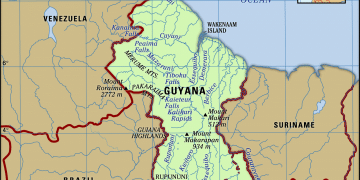
While supportive of the removal of the Maduro regime, Guyanese (and Trini) Americans look on with uncertainty of the future of Guyana’s larger and more resource rich neighbor. They are concerned about what his removal from power mean for Guyana. Will the new political dispensation drop its claim to Essequibo, two-thirds of Guyana. The political climate in Venezuela remains uncertain and it will take some time for clarity on governance. President Trump said Washington will run the country and manage its oil resources until such time that there can be a safe, proper and judicious transition. As long as the USA is in control in Caracas or Miraflores, Guyana does not need to worry about the claim to Essequibo. But the government that replaces the American presence could revive the claim to Essequibo. Before the Americans hand over control of Venezuela to a new administration, Guyanese say that Washington should get a guarantee from the successors that they will accept the ruling from the World Court (ICJ) on the border controversy that is expected by next year. Guyanese Americans hope that the Venezuelans in Guyana will return to their homeland to assist in re-development. Trini Americans also express similar hope as Venezuelan migrants are burdening the resources of the country. The anti-Americans and those who condemn the American actions in Venezuela cannot protect Guyana.