














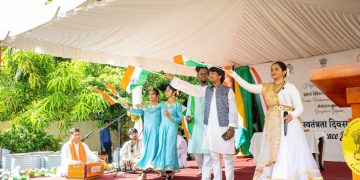
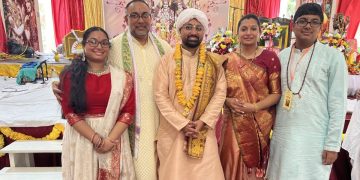
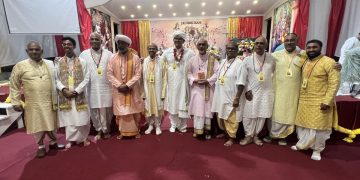








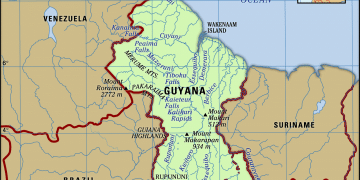














(Indian) Arrival Day in Guyana, celebrated annually on May 5, commemorates the first arrival (1838) of Indians to the South American British colony and those that came after and their (and their descendants) contributions to the colony and to or in the post independent (1966) nation. The granting of this annual holiday from 2004 involved a long struggle by Indian rights activists including this writer and cultural organizations; Desmond Hoyte gave a one off holiday in 1988. The demand was for Indian Arrival Day, but the government named it Arrival Day. And although not a holiday, the day, May 5, was observed with cultural programs and lectures going back to 1938, the centenary of the arrival of Indians to Guiana. Indians celebrated the day, Rama Khan Day, as their holiday amidst opposition from the colonial authorities and subsequently by the post independent government. Gandhi Youths and other groups were in the forefront of the celebrations and championing recognition for Indian Arrival. But it was denied by the government. Similar demands were made in Trinidad for IAD as a holiday for decades but rejected by the PNM government. In Trinidad, IAD was celebrated long before it became a holiday in 1995.
Since the centennial in 1945, IAD was observed in Trinidad annually. IAD celebrations throughout Guyana and Trinidad and in the diaspora have contributed to the resurgence of Indian culture in the Caribbean and the diaspora.
Several individuals and organizations championed the struggle for IAD as a holiday in Trinidad. Haripersad Harikissoon, Mangal Chatergoon, Sat Maharaj, Ramdath Jagessar, Hanoman Doolarchan Hanomansing, Kamal Persad, Ashram Maharaj, Hindu Seva Sangh, Indian Review Committee, Maha Sabha, among others championed IAD as a holiday. Jagessar developed the concept and was joined by others. Kumar Mahabir, Samaroo Siewah, Rajnie Ramlakhan, among others also provided support for IAD as a national holiday. Several of us from New York, including this writer (Vishnu Bisram), Vassan Ramracha and Rennie Ramracha provided solidarity and moral and financial support for the struggle in Trinidad. We also lobbied politicians to support the idea of a national holiday. Rennie, Vassan, and myself flew down from 1981 to observe the annual Indian Arrival celebrations in Trinidad. Trevor Sudama, Raymond Pallackdharrysingh, Kelvin Ramnauth, Basdeo Panday, among others presented and defended the bill for a national holiday. Several prominent politicians who supported the idea before becoming elected to office opposed the proposed holiday when they became office holders in the NAR administration.
We, along with Bhanu Dwarika, Rudra Nath, among others, organized our own annual IAD in Queens from 1985 onwards. Ravi Dev, Iserdat Ramdehol, Roopnarine Persaud, among others also played prominent roles in IAD celebrations in NY.
The Indian Guyanese activists, like this writer, wanted a holiday, an official acceptance and recognition, by the successor government to the British colonial government, of the persecution and oppression of Indians during the indenture period and to celebrate their achievements as well as their overcoming colonial hardships and cultural marginalization.
The activists wanted the Indian national identity and their heritage and contributions to the nation and colony to be officially recognized. The contributions of the 240,000 indentured Indians and their descendants were historically overlooked. Unlike Indians, Africans were honored for their sacrifices during slavery and their freedom with Emancipation Day that has been celebrated annually on August 1 for decades. Throughout the globe, a people’s persecution and or their contributions to society have been recognized. Rights activists have sought a similar recognition for Indians in Guyana. They modeled their activism like what took place in Trinidad that led to the granting of IAD. Initially, the African led government proclaimed the holiday , May 30, as Arrival Day in 1994, the first time it was granted. But Basdeo Panday added Indian to it in 1995.Several Guyanese, including this writer, contributed to that struggle in Trinidad to have IAD become law. The Indian community is deserving of the honor just as they do in Guyana.
In Guyana, a parliamentary committee recommended the holiday as IAD. But the parliament changed it to AD. May 5 applies only to Indians; not other groups is linked to this date. Thus, it should receive its right nomenclature of IAD as championed by a handful of us and popularly supported by all ethnic groups. Several of the activists, including Ravi Dev, Rhyaan Shah, Swami Aksharananda, Baytoram Ramharack, Vassan Ramracha, this writer, among others, had also advocated for a UG campus in Berbice and Essequibo. After initial opposition, the former was established in Port Mourant by President Jagdeo. A UG campus in Essequibo is yet to be established.
Some critics argued that Indian Arrival should not be celebrated but memorialized because of the exploitation, abuse, and trauma that Indians suffered during indentureship (1838-1920). One should not celebrate the enslavement of the indentured Indians. Contrary to what others believe, contemporary Indians are not celebrating the near slave like conditions of their pioneering ancestors but their ability to overcome serious hardship and racism and of their immense contributions to the society. The indentured Indians are deserving of a holiday to recognize their survival against adversity, their achievements, and their contributions to the nation.