























The highly regarded academic Prof Baytoram Ramharack has penned an authoritative book on the Wismar Massacre that took place in 1964 (‘63). It is a very sharp, detailed in-depth study of that tragic episode in our history, a critically acclaimed no holds barred argumentative account, an academic text that is written for easy reading. It is also laced with analysis of the nationalist and ethnic politics around that time.
Guyanese growing up during the early 1960s would be acutely aware that British Guiana experienced a very turbulent and traumatic pre-independence history. The nationalist struggle initiated by Cheddi Jagan and the People’s Progressive Party (PPP) was tainted by ethnic animosity and racial conflict between Africans led by Forbes Burnham and Indians led by Jagan. The European colonizers, in collaboration with some local politicians, encouraged ethnic divisions, which remained with us today, six decades after independence, in an attempt to prevent the Jagan Marxist-led Government from controlling an independent British Guiana. As a result, the political nirvana of peaceful ethnic coexistence remains, to some extent, an elusive promise.
The Wismar Massacre refers to the siege of the minority Indian population residing in the Wismar and Christianburg communities during May 1964. The series of physical attacks, sexual assaults, looting, and arson led to the forced migration of more than 3,000 Indian residents from the area. Several Indians were brutally killed; the exact number remains contentious. To be sure, there were Indian-African ethnic conflicts and reciprocal attacks by members of each community along the coastal areas, but there was always an adjacent village that offered members of a community under attack a blanket of safety and a safe haven to rely on. Such was not the case in Wismar. There was no adjacent community to offer Indians protection, and as Janet Jagan, the then Home Affairs Minister who resigned because of the attacks, noted, there was credible evidence of collusion between the perpetrators and members of the British Guiana Police and Volunteer Force. The “planned” and “organized” attacks (words used by the Commissioners appointed to examine this incident) are collectively referred to as an “ethnic cleansing” by Professor Baytoram Ramharack in his recently published book. Other writers also referred to the attack as ethnic cleansing and a genocide. This publication presents in-depth research that lays out the causes of the Wismar massacre and considers its impact on post-independence race relations in Guyanese society.
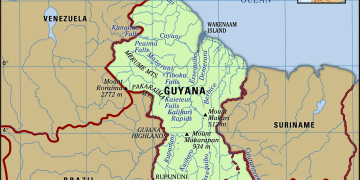
It is difficult to imagine that Linden ( Wismar/McKenzue) today is characteristically devoid of its once-vibrant Indian business community and of its multiethnic population that lived in relative harmony with Africans. The author cautioned readers that an examination of what happened in “Wismar 1964” should not be used by any group to claim victimhood, and that no member of a community should feel morally superior because of the atrocities committed by the “other” during this tragedy. The narrative argues that the voices and experiences of the Indian victims have been silenced, according to the author, because of a historical denial of what happened in Wismar, including uncertainty about what happened to the land and property owned by the victims. Their voices are silenced as no Indian leader, since Jagan in that period, championed them. For many Indians and Africans, Wismar remains a sensitive subject matter. Indian Guyanese in the diaspora commentates the massacre that occurred on May 26, the day chosen for independence. For decades, Jagan was sensitive about celebrating May 26.
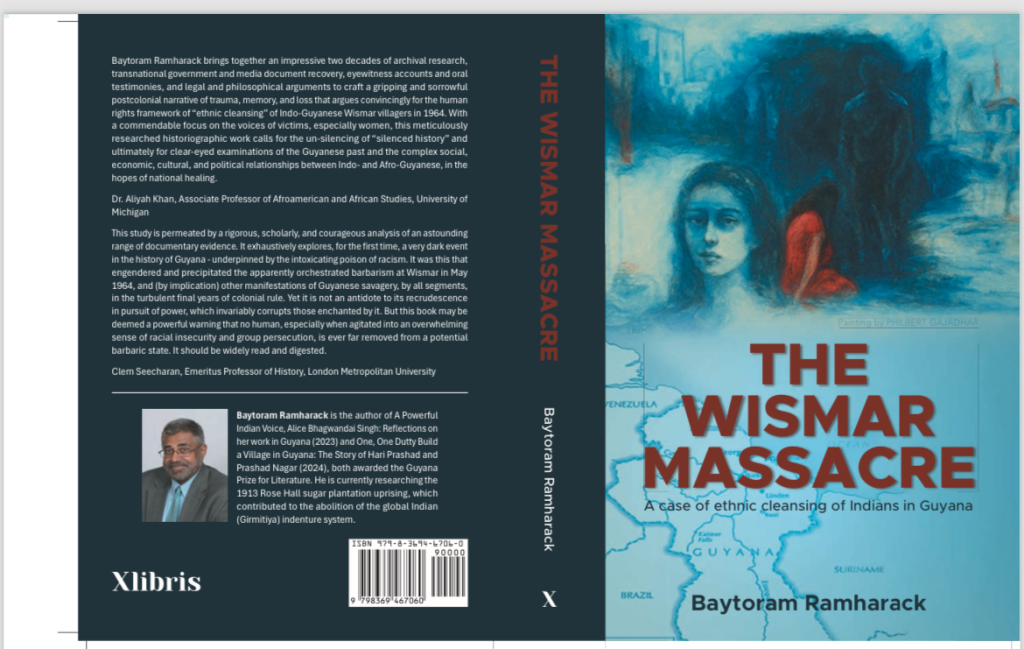 Dr Baytoram Ramharack’s The Wismar Massacre: A case of ethnic cleansing of Indians in Guyana details the causes and impact of the Wismar Massacre of 1964. The study draws on data from the official Wismar Commission Report (presented to the PNC/UF Government in January 1965), as well as analyses of testimonies from eyewitnesses, government officials, and members of the British Guiana security forces. The study also examined the released “secret” correspondence between the Governor of British Guiana and his official overseers in London to gain insight into how the British Government hoped to influence the composition of the Wismar Commission and its findings. The Wismar Commission was composed entirely of Guianese citizens, as opposed to the 1962 Wynn Parry Commission, which investigated the events of February 1962, or the 1965 ICJ fact-finding team, which examined racial disparity in various government and law enforcementagencies.
The author introduces readers to the politics of the 1950s and 1960s, the period that laid the groundwork for the Wismar Massacre. The book explores “themes of ethnic conflict, political manipulation, colonial legacy, and national identity while documenting the experiences of victims and survivors.” As an academic, I have written about the Wismar massacre before, but the details captured and presented in this voluminous study are extraordinarily revealing. Such a massive undertaking, accompanied by Oral History interviews and an Appendix of relevant documents, was intended to capture all the historical elements of this tragedy, which the author admits spanned over two decades of investment in timeless research. The purpose of presenting such a narrative, as the author explains, is to “preserve memory and encourage scholarly discussion about justice, reconciliation, and historical accountability in Guyana” of the 1964 Wismar massacre. An argument is forwarded that the massacre at Wismar seems to have been deliberately erased from historical memory and national discourse since 1964.
This publication is surely going to be a hotly debated topic, especially when placed alongside another major tragedy, the explosion on the Son Chapman (on July 6, 1964), which the author also addressed. The book prompts readers to question whether Guyanese have missed important opportunities to engage in genuine discussions that could lead to ethnic reconciliation and national healing. More importantly, it raises legitimate questions of how the political vehicle of the Indian population, the PPP, has responded to the security concerns of its loyal Indian supporters, which included the Wismar refugees. This book, parts of which may be painful for some with historical memories to read, makes a significant contribution to Guyanese history. It is a great book, highly recommended for its detailed, objective, balanced analysis, evidence driven study of the Wismar violence and of our politics around that period.
Dr. Ramharack must be congratulated for helping us better understand adifficult period in Guyanese history. For a younger generation, this book is a valuable resource for understanding how historical events shaped the political culture of the post-independence generation of Guyanese.
Yours Truly,
Dr Vishnu Bisram