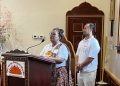















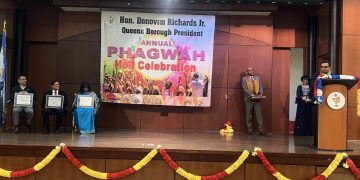












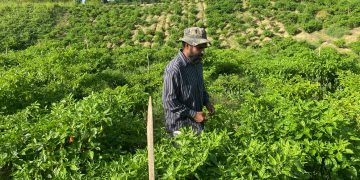
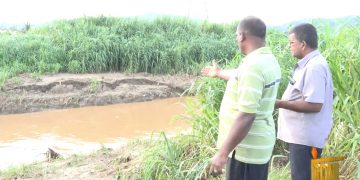


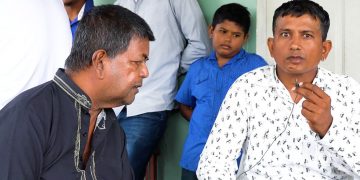








Pandits Vikash Ramkissoon and Vishnu Panday quoted the Hindu scriptures during the parliamentary presentations, giving media attention (in India and parts of the Caribbean) to the mention of the Hindi language in Guyana assembly during the budget debate.
 Pandit Vishnu stated that some 30% of the globe’s population of 8 billion speak Hindi; India’s population is 1.45 billion; most Indians speak Hindi or a version of it. Indians in other parts of Asia, Europe, North America and some in the Caribbean and elsewhere also speak Hindi. Pandit Vishnu quoted a verse in the Ramayana, describing it as Hindi, and translated it to make a point about what he felt is inadequacies of the budget. Pandit Vikash, in response, ‘corrected’ Pandit Vishnu’s description of his quote that Vishnu-ji referred to as Hindi, saying Pt Vishnu was not using Hindi but ‘Awadhi’ (Oudhi). Awadhi is the local language (Hindi dialect) of Benaras, Ayodhya and nearby Fyzabad and Lucknow from where thousands indentured came to Guyana. There is some differences between the two languages, but the meanings are almost the same.
Unless one is proficient in the Hindi language and has studied and or traveled extensively in India, one will not know there are variations of Hindi used in the northern belt from where Indian Guyanese (and most Indo-Caribbean people) trace their root. Indian Guyanese feel (felt) that their ancestors spoke or read Hindi. Most spoke variants or dialects of Hindi and Bhojpuri, a variation of Hindi. Bhojpuri is a sweet, romantic language spoken by over two hundred millions including in Suriname, Fiji, Mauritius, etc.Guyanese won’t know the difference.

Pandit Vikash spent several years studying in Delhi at Delhi University for both his Bachelors and Masters degrees. He is learned in the Hindi language as is the Arya Samaj scholar Dr Satish Prakash who is also proficient in Sanskrit. Vikash ji would also have traveled around northern India. So he would know the variations in the Hindi language and the cuisine. He is also proficient in the Hindu scriptures. I don’t know if Pandit Vishnu studied in India, but I am told he spent time in India studying sugar production. He knows Hindi and its variations and is also well versed in the Hindu scriptures; he quoted the verse from the holy Ramayana without reading it, illustrating his aptitude.
I traveled extensively throughout India and also studied in India and wrote extensively on indentureship and other topics in India for mass media; I will also be in India later this week and for the rest of the month to speak at several universities on the Indian diaspora. I know a bit about its geography and languages spoken. There are over 100 languages in India and 15 official languages with English and Hindi the largest spoken and written languages; India is the largest English speaking country of a billion. Local Hindi dialects are spoken in different regions of Northern India. Every 30 miles (or so), the dialect (and even the food) is different. The indentured Indians came to Guyana mostly from the Bhojpuri speaking belt (Eastern UP and Western Bihar) and some from South (Madras Presidency or Tamil Nadu, etc., speaking Tamil dialects). Some also came from Awadh (and spoke Awadhi) that Vikash ji referenced; some came from Braj or Brij (Mathura area like my mother’s maternal grandparents and spoke Brij Hindi). Others came from Puravanchal (speaking Bhojpuri like my father’s paternal and maternal grandparents), Bundelkand (Central UP speaking Budelkandi, a variation of Bhojpuri), Pachimi (like in Chapra, speaking a variation of Bhojpuri like my mom’s paternal grandfather or aja), Magadhi (a version of Bhojpuri or Hindi spoken in Gaya, Patna, etc.), and other locales speaking a dialect close to Bhojpuri or Hindi. All the Hindi speaking Indian indentureds came from those areas. The dialects spoken are closely tied to Hindi with some words coming directly from the local area; speakers of the varied dialects understand each other with Hindi or Sanskrit being the mother language. Poets from the local are write in their local language. Some words are slightly different. As an example, “barsha” is rain in Sanskrit and the root of the dialects. “Barish” is Hindi for rain. In another dialect, like Bhojpuri or Awadhi or Magadhi, it is “barka”. Tea is ‘chayam’ in Sanskrit and chai or its variations in Hindi and its dialects. Northern Indian languages are connected with one another and words are similar. In addition to the Hindi dialects in India, the indentureds developed their own dialects, a combination of the dialects brought from India – for example, Sarnami Hindi in Suriname, Fijian Hindi in Fiji, Mauritian Hindi in Mauritius, etc., all a variation of Bhojpuri. I do not know if the indentureds in Jamaica, Guyana, Trinidad, Grenada, St. Lucia, and other territories developed their own local versions of Hindi or Bhojpuri.
Thanks to Pts Vikash and Vishnu, there is renewed attention on Hindi in Guyana.