






















































With the National Security, Department of State, and Related Programs (NSRP) Appropriations Bill for Financial Year 2026 (FY26) only having been finalized only a few months ago following the disruption caused by the government shutdown, the introduction of the FY27 bill to Congress follows sooner than usual. In that context, I was genuinely encouraged that my reflections on FY26 was acknowledged by the U.S. House Appropriations Committee. As a born and bred son of the Caribbean, that recognition carries added meaning, as it suggests that even within a compressed and challenging legislative timeline, there remains space for external perspectives to be heard. For these reasons I commend Congressman Mario Díaz-Balart for fostering that openness in his role as Chair of the NSRP Subcommittee and Vice Chair of the full committee, as I also recognize the Chairman of the Appropriations Committee, Congressman Tom Cole, for his continued leadership in supporting a more inclusive and outward-looking process.
Turning to the FY27 proposal, one element stands out with particular significance for the Caribbean, which is the strengthened commitment to the Caribbean Basin Security Initiative (CBSI). With an allocation of no less than $92.5 million, which represents a second meaningful increase since the 2026 election, this is not merely a budgetary line item, but a strategic signal to the entire region, and well beyond.
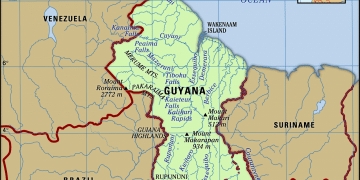
For those of us in the Caribbean, security cooperation with the United States has always existed at the intersection of necessity and geopolitics. The region’s proximity to major narcotics transit routes, compounded by the ongoing crises in Haiti and Venezuela, places disproportionate strain on small island states with limited enforcement capacity. By prioritizing countries most affected by these dynamics, such as Guyana, Trinidad and Tobago and the Dominican Republic, the bill reflects a targeted, rather than diffuse, approach to regional stabilization.
What is particularly noteworthy is the emphasis not just on funding, but on capability. The directive to provide and sustain equipment, such as radars, patrol vessels, vehicles, and helicopters, addresses a long-standing gap in Caribbean security architecture. Too often, assistance has been episodic, lacking the maintenance frameworks necessary for durability as such, this shift toward lifecycle support suggests a more mature understanding of what effective partnership entails. Moreover, the encouragement to utilize Section 516 of the Foreign Assistance Act to transfer excess defense articles introduces an element of efficiency that should be welcomed. For small states, the acquisition cost of such assets is frequently prohibitive. If implemented prudently, this mechanism could significantly enhance maritime domain awareness and interdiction capabilities across the basin.
From a policy standpoint, the CBSI increase also reinforces the evolving nature of U.S.–Caribbean relations. It moves the engagement beyond rhetoric and into tangible cooperation grounded in shared security interests. While some may frame this within the broader strategic posture of the Trump administration, it is equally important to recognize the bipartisan continuity in supporting Caribbean security frameworks as the difference here lies in execution and prioritization.
That having been said, an objective assessment requires acknowledging the challenges ahead, as funding alone does not guarantee the desired outcomes. Institutional capacity, governance standards, and regional coordination will ultimately determine whether these resources translate into measurable gains, and Caribbean governments must therefore meet this moment with equal seriousness, by ensuring transparency, accountability, and strategic alignment in how such assistance is utilized.
For all of these reasons, the FY27 NSRP bill represents a constructive step forward, as it reflects a recognition that Caribbean security is not peripheral to U.S. interests, but integral to them. For those of us in the region, it offers both an opportunity and a responsibility to deepen cooperation while strengthening our own systems.
If FY26 demonstrated that voices from the Caribbean can be heard in Washington, FY27 suggests that those voices can also help shape outcomes, and that in itself is progress worth noting.
Best regards,
Ravi Balgobin Maharaj