









The observance or celebration of Diwali in New York City, indeed in USA, began post 1965 when Hindus from the Caribbean were granted visas under various categories to come to USA, including for employment, and decided to settle down initially in New York and later moved to other parts of the country. Several individuals self-sponsored themselves (green card) to remain in USA through their skills or education and or for having an American-born child. New York was at the time (late 1960s) and still has remained the center of the Indo-Caribbean presence in America although they are found in several cities around the country. Major communities are in Schenectady, Jersey City, Atlanta area, Ft. Lauderdale/Miami, Orlando, Boston, Minneapolis, Chicago, Dallas, Houston, among other cities. Indo-Caribbeans started coming to NY as students, skilled workers (scientists, accountants, medical workers, etc.), and visitors post-1965 when the borders were open to them. They moved to other locations over time. Wherever they settled and had or have had clusters of Indians or Hindus, they have been known to establish social and cultural institutions that have helped to preserve, promote and perpetuate their heritage inherited from India and brough to the Caribbean and then transplanted to America.
Post 1965 and the 1970s were an important period of migration for many Caribbean people to New York. Indians were not allowed in USA until passage of the 1965 Immigration Act. The Act righted historic wrongs of racialized immigration policy that kept out non-Whites. Trinis, Guyanese, and others took advantage of the new law; they came as students and or as skilled workers or as visitors and found ways to earn residency and citizenship. Trinis started coming before Guyanese because they were financially better off than Guyanese to fund the trip or pursue education in America. Indo-Caribbeans arrived in search of better opportunities, education, employment and a brighter future for their families and children. Initially, mostly males came and later sent for female siblings or wives. They faced racial and religious discrimination in the Caribbean as well as limited economic opportunities and viewed immigration as a way out to address these problems. They faced then and still experience all kinds of adversities in America including racism not only from Whites but from Blacks and Hispanics and other minorities. Just like Irish, Italians, and other immigrant groups who brought their cultural practices to USA, Caribbean Hindus brought to America religious customs, values and celebrations that had been carefully preserved by generations of Indo-Caribbean families. And they have retained their heritage that flourishes just like the American pilgrims of five years ago and that of other immigrant groups. Although New York was far removed from the villages, rice fields, sugar estates and neighborhoods of Trinidad, Guyana, Suriname, Jamaica, etc., Diwali, Holi, Eid, Christmas and other festivals brought a little piece of “home” into their new surroundings, their adapted homeland.
Every Hindu, in fact every Indian regardless of religious faith, looks forward for Diwali festival when goodies are shared by Hindus to all neighbors. In New York, one of the most important aspects of Diwali during the 1970s was the opportunity to come together as a community at someone’s home or a rented hall or a large space. Indo-Caribbean Hindus often relied on family networks, friends and fellow immigrants to practice their faith that enables them to maintain their cultural and religious identity. Religious gatherings and social functions provided opportunities to meet others who shared similar backgrounds and experiences. For newcomers from Guyana and Trinidad, these gatherings were especially meaningful. They could speak their familiar Caribbean dialects, exchange stories about home, enjoy traditional food and reconnect with customs that had shaped their childhood. Trinis and Guyanese got along quite well and even shared apartments and or dormitories (students).
For those who experienced Diwali in NY during the 1970s, the memories were often simple but unforgettable. They missed the large celebrations, open spaces and community festivities of the Caribbean. Yet they made the best of their circumstances, creating meaningful celebrations within their small apartments and among their friends. Hindu prayers, devotional music and bhajans helped recreate the atmosphere of the Caribbean mandir. They played related songs from tapes and records on electronic equipment. Conversations often turned to memories of Diwali celebrations back home, where entire villages and neighbourhoods were illuminated with diyas or earthen lamps. The same was also true for observance of Holi when they gathered in an apartment. For adults or older generations, these occasions were also opportunities to teach their children about Hindu values, religious stories and the importance of respecting their ancestors.
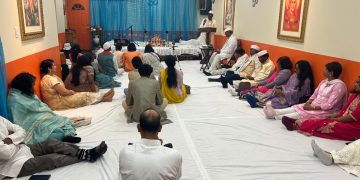
For Hindus who came to NY during the 1960s and 1970s, Diwali was celebrated privately in their small apartments or hotel rooms. Small community celebrations and worshipping took place at hotels — Cleo, Martinique, Clarks, and a few others. Celebrations were started by a group led by Pandit Oumadatt Maharaj of East Coast Demerara and assisted by Pandit Shastri (known as Midget Pandit because he was very short) of Berbice under the Mahatma Gandhi Satsang organization (MGSO). Pt. Chandrika Misir of Berbice also assisted with services; he joined the organization during the 1970s when they were still in Manhattan. Hindus from Guyana, Trinidad and India patronized services on Sunday mornings. From 1969, Sunday morning worshipping as well as observing varied Hindu festivals took place on evenings in apartments in those hotels. Mohanbhog and snacks were prepared for devotees. Diwali was similarly observed in the apartments. An apartment was rented for worshipping. Hindus and Muslims supported each other in their observance of festivals. Both religious groups took turn worshipping and celebrating festivals in the apartment; they supported each other in meal preparation. Several weddings were conducted in these apartments by those three pandits during the 1970s. During the late 1970s, Hindus began moving out if the hotel apartments renting or purchasing homes in Bronx, Queens, and Brooklyn. As Hindus moved from the hotel, the MGSO also shifted its location. Celebrations of Diwali, Holi, other festivals, weddings and community celebrations and worshipping shifted to Jerome Ave (basement of a building acquired by the family of Pt. Gunnar) around 165th Street in Bronx. Worshipping had continued there till the 1980s and probably still does; yagyas and Ramayana kathas were held there for decades. The MGSO moved to 150th Street (off Hillside Ave) during the 1980s at a garage of the home or yard of Pandit Oumadatt. (When the Indians moved out of the hotel apartments, Muslims shifted their celebrations to rented halls).
During the late 1970s and thru the 1980s and beyond, Hindu worshipping and Diwali celebration also occurred in the large basement of a tenement apartment building (Avenue D) in East Flatbush area owned by a Guyanese family (Pt. Tiwari?) from Berbice. It was known as the Brooklyn Hindu temple Society. That basement also hosted celebrations relating to Holi, Diwali, and other religious festivals as well as Ramayana discourses. Hindu weddings were also held there. Several other basements in Queens and Brooklyn or empty apartments served as temples during the 1980s. Pt. Ramlall donated the large basement of an apartment building as a make shift Arya Samaj Temple. Vishnu Bandhu also made available his rented building that hosted a carpet store as a make shift temple and a hall for cultural variety concerts. Several kathas, Diwali and Holi celebrations were held at his location at 1262 Broadway in Brooklyn. Aunty Betty (deceased in 2026) also allowed usage of an apartment and basement to serve as a makeshift temple where Arya Samaj services and concerts were held. Besides Indo-Caribbeans, Indias from India also patronized celebrations or observance of Hindu festivals.
For Indo-Caribbean Hindus, who during the 1960s thru 1980s were mostly from Trinidad and Guyana, occasions such Diwali, Holi, Navratri, Shivratri and other auspicious occasions were much more than religious festivals. (Surinamese started coming to NY and Florida late 1980s). A few Jamaicans and Indo-Caribbeans from other islands patronized temple services of Trinis and Guyanese and the Ashram on 153rd Street in Jamaica, Queens. Celebrating Diwali and Holi and other festivals were treasured reminders of their ancestral roots, their upbringing in the Caribbean and the cultural traditions they carried across the waters to a new country. Diwali, Holi, and other festivals were brought to the Caribbean by Hindu indentured laborers from India. The Hindu migrants from the Caribbean transplanted the festivals in USA.
Celebrating Diwali or other festivals in New York during the 1970s was not always easy. There were very few Hindus around for traditional celebrations. There were no mandirs or Hindu or Indian Caribbean organizations. Unlike Guyana and Trinidad, or Suriname, where Hindu communities had long-established traditions of public celebrations, NY’s Indo-Caribbean Hindu population was still developing its community institutions.
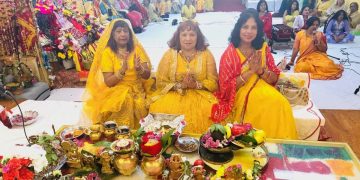
Many families lived in small apartments and modest homes, where space was limited. Nevertheless, they found ways to observe the festival in their homes. Most of them had a little prayer altar like what they had back home in Guyana, Trinidad, Suriname, Jamaica. Homes were cleaned and decorated, diyas were lit. Where they could not obtain diyas, they improvised with ‘luye’ made from flour and water shaped like a diya; roti is made from ‘luye’. Hindus offered prayers in the evening on the night before Diwali and lit a diyas on the altar and one in front of the door to the apartment. The spiritual meaning of Diwali remained at the centre of the celebration. Families gathered for puja, offering prayers to Goddess Lakshmi and Lord Ganesha, seeking blessings for prosperity, wisdom and happiness. On Diwali night, they lit a diya on the altar, in front of the door’s entrance, and in each room.
Traditional sweets and delicacies and meals like those served back in Guyana or Trinidad were prepared for the occasion. These included mithai, mohanbhog, parsad, kurma, goja, bara, phulourie, sahena, baiganee, alou curry and dhal puri or paratha roti. Neighbors or kins made different sweet items and shared with one another. The familiar aromas of these homemade dishes brought back memories of childhood celebrations in the Caribbean. The kitchen became a place where culture and tradition were preserved. Recipes passed down from mothers to daughters and grandmothers to grandchildren ensured that the taste of home remained alive, even thousands of miles away from India and from the Caribbean.
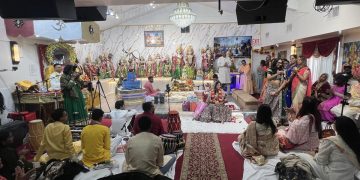
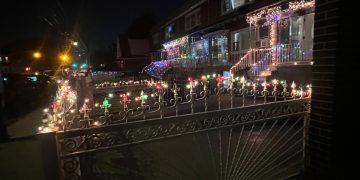
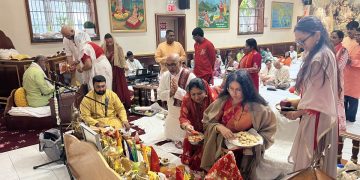
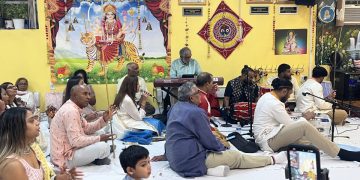
During the 1980s, when tens of thousands of Hindus migrated from the Caribbean to NY, institutions like mandirs were established. At first, buildings were converted into mandirs. And later, mandirs were erected anew or from scratch especially during the 1990s and beyond. Some families travelled to the mandirs or temples for worshipping and observing the varied festivals. Before mandirs were established, celebrations were held in auditoriums – diyas were lit in auditoriums and concerts organized; Diwali concerts were also held in open private owned spaces where tents were constructed for the occasion. As more and more Hindus acquired houses, Diwali was proudly celebrated in their homes with diyas and electronic lights.
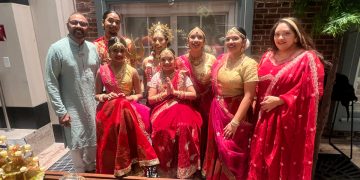
Pandits and elders played an important role in helping families maintain their spiritual practices. Devotional songs, bhajans and the recitation of religious scriptures as well as playing musical recording of religious songs provided a familiar atmosphere that reminded many immigrants of the mandirs and community gatherings they had left behind. There was the excitement of dressing in new clothing, visiting relatives, preparing sweets and gathering around the family altar. Children looked forward to the lighting of the diyas and the opportunity to enjoy the special foods prepared for the occasion.
In a huge modern cosmopolitan city like NY, filled with different cultures, languages, traditions, and heritage, the celebration of Diwali provided an opportunity for Hindus to preserve their faith, strengthen family bonds, and maintain a connection with the culture of home, be that Guyana, Trinidad and Tobago, Suriname and of their Indian heritage.
In neighbourhoods where Indo-Caribbean communities were beginning to establish themselves, Diwali became a symbol of belonging and cultural pride. Queens, particularly areas that would later become major centres of Indo-Caribbean life, gradually developed a stronger presence of Caribbean Indian families. Indo-Caribbean communities have also been established in Brooklyn on the border of Queens and in Flatbush as well as in the Bronx and Jersey City. The foundations of the vibrant Hindu and Indo-Caribbean communities visible in New York today were being established during the 1970s and 1980s.
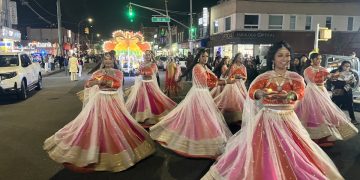
The Indo-Caribbean Hindu community in NY have continued to grow and organize itself throughout the 1980s and beyond. Religious and cultural organizations have helped establish stronger community networks, creating opportunities for larger celebrations and greater public recognition of Hindu festivals. From a few in the 1980s, dozens of mandirs sprung up during the 1990s and beyond. Over time, Diwali became increasingly visible in NY’s multicultural landscape. What had once been celebrated primarily within family homes and small community gatherings developed into larger public observances, cultural programs and religious celebrations. The growth of the community reflected the determination of Indo-Caribbean immigrants to preserve their heritage while embracing life in America.
Looking back, Diwali in New York City during the 1970s represented the courage, faith and cultural determination of Indo-Caribbean Hindus and those from India who dwelled among the Caribbean Hindus. They were immigrants building new lives in an unfamiliar environment, yet they refused to abandon the traditions that connected them to their ancestors. Through prayer, food, traditions, family gatherings and the lighting of small diyas, they kept their heritage alive.
Those early celebrations helped lay the foundation for the flourishing Indo-Caribbean Hindu community that NY enjoys today. As tens of thousands gather to celebrate Diwali throughout Queens, Brooklyn, Bronx, Schenectady and other parts of the country, it is worth remembering those families and pandits, elderly females, who kept the tradition alive when the community was much smaller. Their little diyas may have illuminated only a doorway or a modest apartment, but their significance reached far beyond those walls. They represented faith in a new country, pride in an ancestral heritage and hope for future generations.
The Diwali celebrations of the 1970s remind us that although Indo-Caribbean Hindus travelled thousands of miles from their ancestral homeland, they never allowed the light of their culture and faith to be extinguished.
May the light of knowledge, peace, prosperity and unity continue to shine throughout New York City and the world.