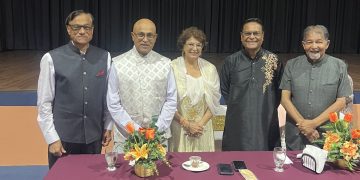




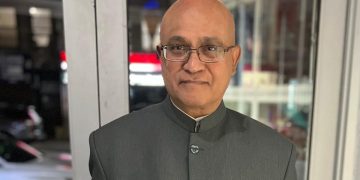



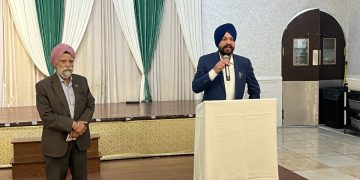


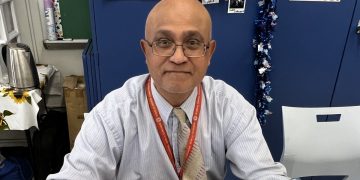




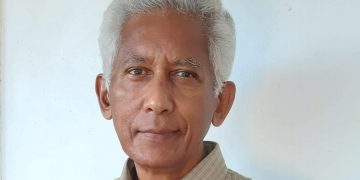
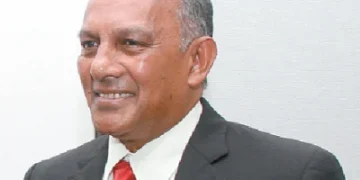
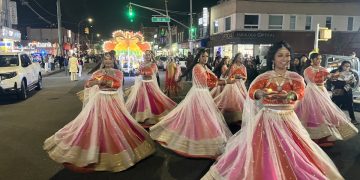
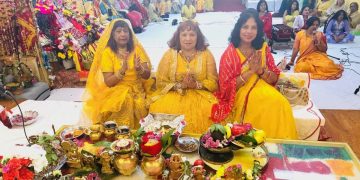
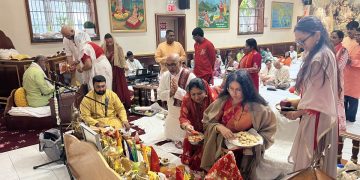
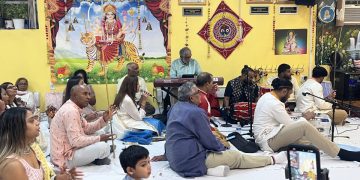
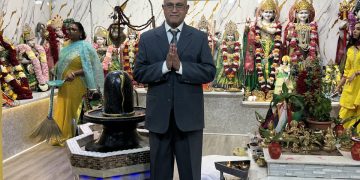
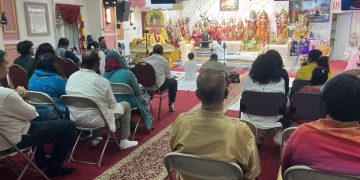
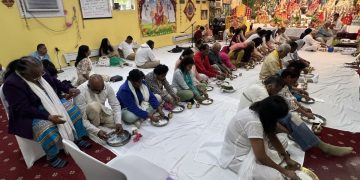
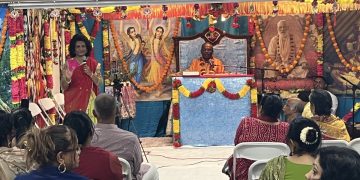
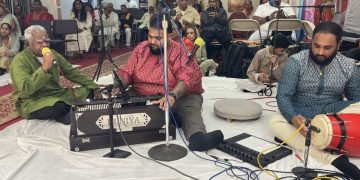
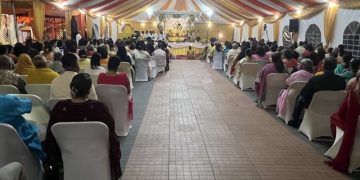
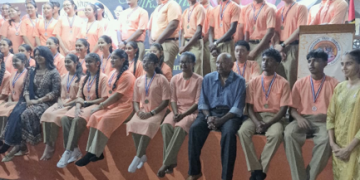
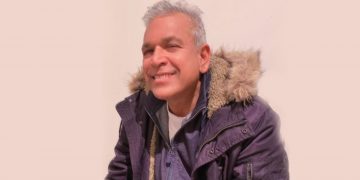


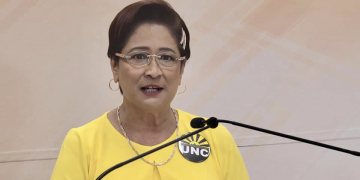


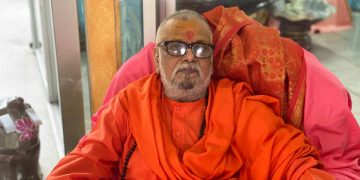




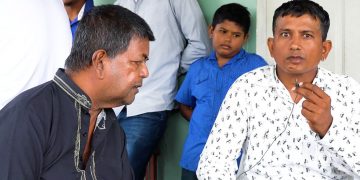
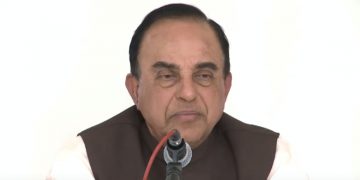


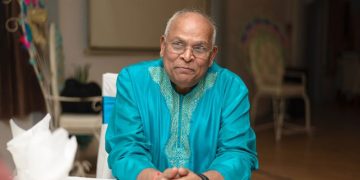



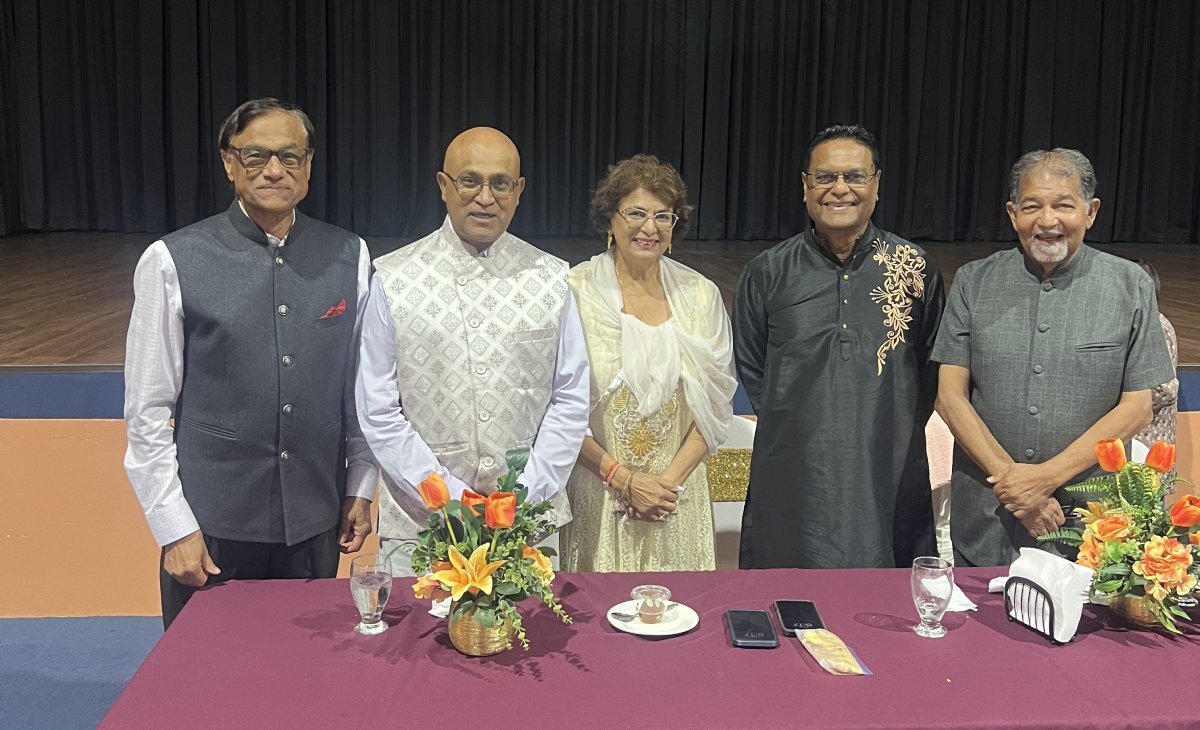
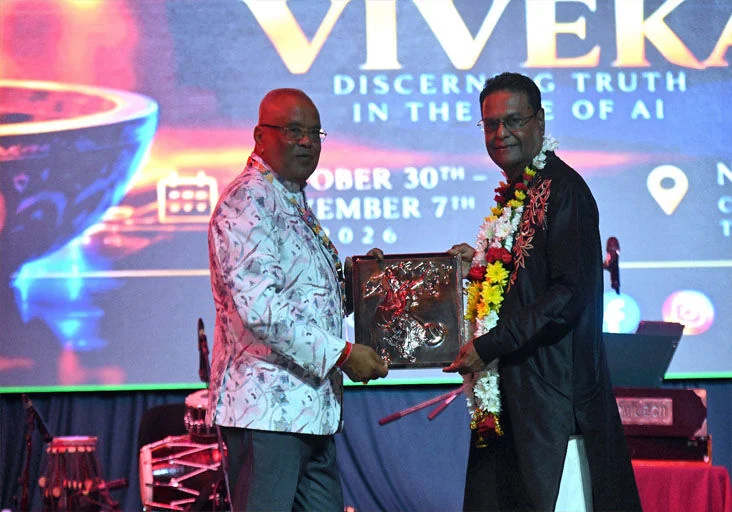
CHAGUANAS, TRINIDAD AND TOBAGO – Diwali Nagar 2026 opened on Friday evening October 30 with dinner and a spectacular display of electronic and traditional deya lights as well as with aartee. The nightly festival continues thru Saturday November 7 with fireworks. The organizers also observed forty years since the festival began. There were diplomats and community leaders, pandits, invited guests. The Speaker of the National Assembly of Guyana Manzoor Nadir was the Chief Guest on the opening night. Suruj Rambachan was guest of honor on second night. The President Christene Kangaloo was also a Chief Guest on November 4. PM Kamla Persad Bissessar was due to attend final night.
Forty years after it began as an initiative to preserve and promote the rich cultural and religious traditions of the Indian community, Diwali Nagar in 2026, as in previous years, has once again transformed Chaguanas into a spectacular centre of Indian heritage, spirituality, entertainment, commerce and multicultural fellowship.
Organised by the National Council of Indian Culture (NCIC), the nine-day festival, running from October 30 to November 7, marks a historic milestone in the evolution of one of the Caribbean’s most important cultural institutions. This year’s celebrations carry the theme, “Viveka: Discerning Truth in the Age of AI,” bringing together ancient Indian philosophical wisdom and the challenges and opportunities of a rapidly changing technological world.
The 40th anniversary is particularly significant for Trinidad and Tobago’s Indian community, whose ancestors arrived from India as indentured labourers beginning in 1845. Through extraordinary sacrifices, resilience and determination, successive generations preserved their religious beliefs, languages, music, dance, cuisine and customs while contributing enormously to the social, economic, political and cultural development of their adopted homeland.
Diwali Nagar has become one of the most visible expressions of that historical journey. It is not simply a festival; it is a living institution that celebrates the survival, continuity and evolution of Indian civilisation and its influence on Caribbean society.
Four decades of cultural preservation
The establishment of Diwali Nagar in 1986 represented a visionary undertaking by the NCIC. Its founders recognised that cultural traditions must be actively preserved, celebrated and transmitted to younger generations if they are to survive the pressures of modernisation and assimilation.
Over the decades, the Nagar has grown from a relatively modest cultural gathering into an internationally recognised showcase of Indian heritage. The NCIC describes it as the largest celebration of Diwali outside India.
The Nagar provides an opportunity for thousands of visitors to experience different dimensions of Indian civilisation, including Hindu philosophy, religious observances, traditional arts, classical music, folk dances, cuisine, handicrafts and commercial enterprise.
For the descendants of Indian indentured immigrants, the event also carries a deeper historical meaning. It represents the remarkable journey from the arrival of their ancestors at the Port of Spain and the sugar estates of Trinidad to the establishment of a vibrant, confident and influential community that has made its mark throughout the Caribbean and beyond.
The Nagar is therefore both a celebration of heritage and a tribute to the generations who refused to allow their cultural identity to disappear.
Viveka: Ancient wisdom meets artificial intelligence
The 2026 theme is especially relevant at a time when artificial intelligence is transforming education, business, communication, research and virtually every aspect of human activity.
Viveka, an important concept in Indian philosophy, refers to discernment, wisdom and the ability to distinguish between truth and falsehood, right and wrong, and knowledge and ignorance.
By selecting this theme, the NCIC has demonstrated that Indian cultural institutions can engage meaningfully with contemporary global developments without abandoning their philosophical foundations.
Artificial intelligence offers extraordinary opportunities for human advancement, but it also raises questions about misinformation, ethics, privacy, accountability and the responsible use of technology.
The message of Viveka is that technological progress must be accompanied by human judgment, moral responsibility and intellectual wisdom. Machines may process enormous quantities of information, but human beings must retain the ability to evaluate information critically and distinguish authentic knowledge from deception.
In this respect, the 2026 theme reinforces the continuing relevance of India’s ancient intellectual traditions in addressing the challenges of the modern world.
A showcase of Indian arts, culture and traditions
One of the major attractions of Diwali Nagar is its impressive programme of cultural presentations. Throughout the nine nights, local and international performers showcase the diversity and richness of Indian artistic traditions.
Classical Indian dance, folk performances, devotional music, instrumental presentations and contemporary entertainment provide audiences with an opportunity to appreciate the extraordinary variety of India’s cultural heritage.
Special attention is also given to young performers through programmes such as Yuva Manch and youth dance competitions. These initiatives provide a platform for emerging talent and encourage younger generations to develop an appreciation for Indian music, dance and artistic expression.
The participation of international cultural groups further strengthens the Nagar’s global character, creating opportunities for cultural exchange and connections between Trinidad and Tobago, India and other countries with substantial Indian diaspora populations.
The attendance of President Christine Kangaloo and First Gentleman Kerwyn Garcia at the celebrations on November 4 added to the national significance of the 2026 edition. Their presence demonstrated the importance of Diwali Nagar as an institution that has become part of the national cultural landscape.
A meeting place for business and economic opportunities
Beyond its religious and cultural dimensions, Diwali Nagar has developed into an important commercial and entrepreneurial platform.
The trade and commercial exhibition features businesses displaying traditional clothing, jewellery, handicrafts, household products, technology and a wide variety of goods and services. Small businesses, artisans, entrepreneurs and established corporations benefit from the opportunity to reach thousands of potential customers.
The food village is another major attraction. Visitors enjoy an extensive selection of vegetarian Indian and Caribbean delicacies, including roti, doubles, saheena, baiganee, sweets and traditional dishes prepared using recipes passed down through generations.
For many families, visiting the Nagar is as much a culinary experience as it is a cultural outing.
The commercial dimension also creates opportunities for businesses to establish new relationships, promote products and services and explore partnerships. It demonstrates how cultural festivals can contribute to economic activity while supporting small enterprises and preserving traditional skills.
The NCIC’s decision to ban the sale of fireworks within the Nagar compound in 2026 was another important measure aimed at strengthening public safety and providing a more secure environment for visitors, vendors, performers and families.
An important institution for the Indian diaspora
Diwali Nagar’s importance extends well beyond the boundaries of Trinidad and Tobago. It has become a significant point of connection for the wider Indian diaspora, particularly descendants of indentured immigrants in Guyana, Suriname, Jamaica, Fiji, Mauritius and other countries. Guests from around the region and from the diaspora visited the Nagar.
These communities share a common historical experience: the migration of their ancestors from India during the nineteenth and early twentieth centuries and their subsequent establishment of new societies while maintaining connections with their ancestral civilisation.
The Nagar provides an opportunity to celebrate those common historical and cultural bonds. It also offers a platform for strengthening relationships with India through cultural diplomacy, tourism, educational exchanges and business collaboration.
As India continues to expand its international economic and diplomatic engagement, institutions such as the NCIC can play an important role in bringing India closer to its global diaspora.
The descendants of indentured immigrants are not merely custodians of historical memories. They are professionals, entrepreneurs, academics, political leaders, cultural ambassadors and investors who can contribute to stronger economic and cultural relations between India and the countries in which they reside.
Diwali Nagar is an excellent platform for nurturing these relationships.
NCIC’s achievement and the road ahead
The 40th anniversary is also an occasion to recognise the dedication of the NCIC’s leadership, members, volunteers, cultural organisations, religious institutions, sponsors and supporters who have sustained the Nagar over four decades.
Organising an event of this magnitude requires considerable financial resources, planning, coordination and public support. The 2026 celebrations were projected to attract more than 300,000 visitors, underscoring the enormous public interest in the festival.
NCIC President Dr Surujdeo Mangaroo and his team deserve recognition for continuing the institution’s work and taking the Nagar through this important anniversary year. The organisation has had to navigate financial and sponsorship challenges, but its determination to proceed with the celebrations reflects the importance of the institution to the national community.
The NCIC should now build on the 40-year achievement by further internationalising Diwali Nagar, strengthening its educational programmes, expanding business participation and creating greater opportunities for young people.
Greater collaboration with Indian cultural organisations, universities, diaspora institutions and business associations could transform the Nagar into an even more significant international centre for Indian heritage and cultural exchange.
A celebration of light, identity and national unity
Ultimately, the greatest achievement of Diwali Nagar is its ability to bring people together.
Although rooted in Hindu religious traditions and Indian culture, the celebrations welcome people from every ethnic and religious background. Trinidad and Tobago’s multicultural character is reflected in the thousands of visitors who come to enjoy the performances, food, exhibitions and festive atmosphere.
The message of Diwali, the triumph of light over darkness, good over evil and knowledge over ignorance, transcends religious and geographical boundaries.
As Diwali Nagar completes its 40th anniversary, it stands as a remarkable testament to the determination of a community to preserve its ancestral heritage while embracing the opportunities and responsibilities of modern society.
From the first Nagar in 1986 to the impressive 2026 celebrations, the NCIC has helped ensure that Indian culture remains a vibrant and integral part of Trinidad and Tobago’s national identity.
Forty years of Diwali Nagar is not merely a celebration of the past. It is a declaration of confidence in the future – a future in which cultural diversity is respected, heritage is preserved, young people are inspired and communities work together.
The thousands of lights illuminating the Nagar are therefore symbolic of something much greater than a religious festival. They represent the enduring spirit of a people, the strength of their cultural identity and their contribution to a united and progressive Trinidad and Tobago.
Happy 40th Anniversary, Diwali Nagar!
CLick here for more picture, https://www.facebook.com/share/p/1Dx7AU7DuT/