










The Indo-Guyanese (Indo-Caribbean) presence in New York and America is relatively new, from the 1960s, compared with say other immigrant groups that have settled in New York and USA decades earlier. Indo-Guyanese began arriving in New York City in the 1960s — largely as students, tourists, and skilled workers before growing today into a major community of hundreds of thousands across the city. Very little has been written on their early presence – how, when, and why Indo-Guyanese came to USA and where they initially lived before establishing distinct Indo-Guyanese communities such as Richmond Hill, Jamaica, Hollis, Briarwood, Queens Village, Cypress Hills, Ozone Park, Parkchester, etc. This essay attempts to narrate and explain the history of Indo-Guyanese presence in America. The focus is on the Indo-Guyanese in New York City as it was the draw, the port city, where Guyanese and Caribbean immigrants first arrived during the 1960s, 1970s and 1980s and beyond before moving on to other areas in America. New York remains the largest attraction of Indo-Guyanese, followed by Florida and other cities. Indo-Guyanese, Indo-Caribbean people are found in virtually all parts of USA but ‘communities’ (places where they clustered and share common heritage, goals, values, culture, interests, etc.) are only established in a few areas or cities like greater Orlando, Ft. Lauderdale, Schenectady, greater Miami, Boston, Atlanta, Minneapolis, Jersey City, Houston, Dallas, among others. Once significant numbers of Indo-Guyanese or Indo-Caribbeans cluster in an area, they begin to establish social and cultural institutions (places of worship, ethnic shops, bakeries, clubs, organizations, day care centers, etc.) that serve as an attraction to gather, to socialize, to make them feel ‘at home’, expanding the size of the community in those areas. The number of Indo-Guyanese (those who migrated from Guyana, other secondary places, and born in USA to Guyanese parentage is not known (but is estimated at around 700,000), and they are heavily concentrated in a few states like New York, New Jersey, and Florida.
The history of Indo-Guyanese presence (immigration to and) in the United States is a dynamic narrative of migration, adaptation, struggle, experiencing racism, overcoming adversity, cultural institutionalization and diffusion, and of a people’s profound socioeconomic impact on (the areas where they reside in) the US as well as on the people (community or society they establish) themselves (itself) and on their home country, Guyana and to a lesser extent on India, their ancestral homeland. It is noted that Indo-Guyanese can hardly be distinguished or separated from other Caribbean people (or other ethnic immigrant groups) in terms of immigrant adaptation, employment, culture, settlement, and establishment of institutions. It is also noted that Indo-Guyanese are a subset of Indo-Caribbean people in America and in the diaspora. And Indo-Caribbeans themselves are a subset of the larger Indian diaspora group of people in USA, Canada, UK, among other countries. And as such when one writes on or studies Indo-Guyanese migration and presence in USA or Canada or UK, it is difficult to separate them from Indo-Trinidadians and other Indo-Caribbeans as they all have migrated to USA for similar reasons, faced analogous challenges of settlement, tend to live among one another for support and solidarity as newcomers in a strange environment, collaborated with and helped each other, are grouped together for census or identification purposes, and share similar ethnic and cultural traits (Trinis and Surinamese, in particular and other Indo-Caribbeans to a lesser extent) and jointly built institutions that benefit all Indo-Caribbeans, other West Indians, and the Indian diaspora. They have common features of diet and dietary restrictions, worshipping, entertainment, sports, traditional clothing, and social and cultural life and share organizations, clubs, offices, places of worship, as well as other institutions. They also tend to patronize each other’s events, programs, restaurants, groceries, temples, masjids, and other institutions. Thus, a write up on or a study of Indo-Guyanese Americans would not be significantly different from a say a study of Indo-Trinidadians and most other Indo-Caribbean Americans in general. (This is not to say that there are no differences between or among the different national groups in the Caribbean and in the diaspora but in North America, they dwell among each other with many inter-marriages). Also, a write up or study on Indo-Guyanese community inevitably and ineluctably draws reference to Indo-Trinidadians, the second largest Indo-Caribbean group in USA, because they dwell among each other and share (together built) institutions in every community throughout America.
As among the largest English-speaking Caribbean diaspora groups in the U.S, behind Jamaicans (combined of all ethnicities), Indo-Guyanese have a long-standing presence that dates back to the 1960s. Some Afro Guyanese (like Ptolemy Reid and Hugh Cholmondeley) and Indo Guyanese (like Dr Cheddi Jagan, Dr Balwant Singh, Dr. Jung Bahadur Singh went to USA to pursue tertiary education as Guyana lacked a university. In addition to these well-known figures, a small number of Afro Guyanese students attended historically Black colleges and universities (HBCUs) such as Howard University, Tuskegee Institute, and Lincoln University, as well as institutions in New York and Chicago, before returning home to contribute to Guyana’s civil service, medical field, and independence movement. They came to USA as students in the first half of the 20th century, but they did not settle down and establish communities as later migrants. They returned to home country as non-Whites were not welcomed in USA, and they wanted to contribute to developing their home country. Several Indo-Guyanese went to USA to study during the 1950s and early 1960s and also returned home after completing their studies.
It is not known who were among the first Indo-Guyanese to migrate and settled in New York, the place where Indo-Caribbeans first arrived and settled and established communities and social and cultural institutions. Early Indo-Guyanese migrants settled in various sections of Manhattan where rent was very low (downtown, west-side, uptown, lower Manhattan, midtown in low-cost hotels like Martinique, Clarks, etc.), the Bronx, around 160th Street and Hillside in Jamaica, Queens, and Williamsburg and lower Flatbush in Brooklyn; Indo-Trinis settled in same areas as Indo-Guyanese. Eventually, Indian Guyanese and Trinis would establish communities and social and cultural institutions in Queens, Bronx, and Brooklyn. Indian and Afro-Guyanese historically have lived in different communities in Guyana and in Trinidad and have also developed similar patterns of settlement in USA – different and distinct communities (Indos largely in Queens and Bronx and Brooklyn (Cypress Hills) border of Queens and Afros largely in Brooklyn (Flatbush, Canarsie) and sections of Rosedale, Laurelton, and Cambria Heights of Queens). Members of both groups have patronized each other’s restaurants. Afro-Guyanese and other Afro West Indians have routinely patronized Indo-West Indian shops in Richmond Hill and elsewhere.
It is not known exactly when Afro Guyanese emigrated and established communities in Brooklyn (probably during the 1980s), but Indians began clustering in communities in late 1970s. There are no known ethnic enclaves among Afro-Guyanese like those of Indo-Guyanese. Afro-Guyanese dwell among other Afro-West Indians. In contrast with Africans, by mid-1980s, Indian Americans (including Trinis) had functioning institutions in several sections of Bronx (like Parkchester, Westchester, Cypress, Soundview, Grand Concourse, Fordham, among others), Brooklyn, and Queens. (Given the pervasiveness of migration, it is not inconceivable that African Guyanese presence in USA existed before the 1960s. This writer came across a few older Afro-Guyanese from the Carolinas who claimed that their parents migrated from British Guiana, pre-dating Indian Guyanese presence but they did not establish distinct Afro Guyanese communities as later migrants in the 1980s and beyond). Also, African Guyanese were known to migrate to USA before Indians as professionals (accountants, clerks, health or hospital workers) and farm workers and pawn boilers in sugar production in the Carolinas, Georgia, and Louisiana. The post-World War II era saw the introduction of the H-2 guest worker program, which brought Guyanese (of both major races) and other West Indian agricultural laborers to U.S farms who returned home after the harvest and as such did not establish communities as now exist.
The structured waves of ‘voluntary’ African and Indian Guyanese migration began in earnest during the late 20th century, post 1965 Immigration Act that was triggered by the Vietnam War. Prior to 1965, Immigration Laws favored Whites from Europe and excluded non-Whites. The Vietnam War opened up American borders to non-White migrants. This key legislative and geopolitical change fundamentally reshaped migratory flow to America. Before the war, almost all immigrants were from Europe as USA had laws denying non-Whites entry. Vietnam War resulted in serious shortage of labor of all types – manual, professional, skilled, farm workers. WWII also led to a shortage of labor. Laborers and professionals from around the globe, including from Guyana and Trinidad, sought better economic opportunities in American agriculture (sugar cane cultivation) and urban industries than in their home countries. There were far more opportunities for Guyanese, Trinis, and other West Indians in USA than available in their home countries. The landmark Immigration and Nationality Act of 1965 signed into law by President Johnson, which dismantled restrictive (White) national-origin quotas. The 1965 Act lifted restrictive quotas sparking a mini wave of skilled and professional (Indo and Afro) Guyanese and Trinidad migration to NY; scientists, engineers, domestic servants, medical workers, accountants, bookkeepers, garment workers and others journeyed out of Guyana. They came in unlimited numbers, mainly as professionals (e.g., doctors, nurses, engineers, and other professionals), but also as students and domestic care workers (babysitters and caregivers of seniors). The health care workers played an important central role in hospitals in the city as well as outer city and on Long Island.
Many were illegals or undocumented workers. Students seeking to upgrade their skills also migrated and began to work. Settling primarily in the metropolitan hub of New York City, Indo-Guyanese would establish vibrant enclaves (in Bronx, Brooklyn, and Queens) that served as centers for community building and cultural preservation. Initially, they settled in poor neighborhoods of downtown and mid-town Manhattan before moving out to the outer boroughs (becoming homeowners) after they obtained permanent residency status and citizenship. They tend to cluster in enclaves or neighborhoods establishing communities distinct from other ethnic or national groups.
In the 1960s and beyond, more Indian than African Guyanese migrated to and settled in USA. As Indian migration increased dramatically during the 1970s, African migration picked up, increasing substantially during the mid-1980s and later years as the Guyanese economy deteriorated. But Afro migration lagged behind Indos because the former had greater opportunities for jobs and tertiary education than the latter in Guyana; the government favored Africans over Indians who were victims of racism. Overall, Indian migration doubled that of Africans from 1960s thru 2025 because of pervasive racial discrimination and victimization that Indians faced (1965 thru 1992) living under a totalitarian oppressive regime, propelling them to migrate. Even after democracy was restored in 1992 and an Indian political party ascended to power, Indian migration has still outpaced Afros and other ethnic Guyanese group till this day because of the state of economy and the culture of chain migration. Of the Guyanese diaspora in USA, of about one million, Indians are estimated at over 60%.
Today, the Indian Guyanese American diaspora stands as a cornerstone of the broader Indo-Caribbean and (South Asian) Indian American (diaspora) experience in USA. They and other Indo-Caribbeans are a sub-group of the larger category of Indian Americans. Indians from India or another country say like from Fiji or Nepal or Bangladesh, or Africa or elsewhere are distinct groups having their own communities and institutions. And while there have been Indians from Africa, Fiji, Mauritius, Southeast Asia, among other places in New York (as well as in Florida and other parts of USA) settled in America since 1960s, none of the other Indian groups from the global Indian diaspora settled in USA has established such a society or community group as Indo-Caribbeans (Indo-Guyanese) wherever they have settled (clustered) in America. Indo-Guyanese and Indo-Caribbean people are settled primarily in New York, New Jersey, and Florida with small numbers elsewhere with institutions like ethnic groceries, restaurants, bakeries, mandirs, masjids quickly springing up. And apart from those who come directly from India to USA, none of the sub-sets of Indian Americans has had such an impact on their locality and America as Indo-Guyanese or Indo-Caribbean people in terms of cultural activities, economic contributions, helping the poor with food programs and shelters, etc. From traditional culture to worshipping, music, literature, cuisine, education, professional jobs, and economic contributions, individuals of Indian Guyanese descent have left an indelible mark on the fabric of their neighborhood in New York or American society (wherever they are settled and established communities of Little Guyana). Indo-Guyanese have organized activities for seniors inclusive of all races, celebrated traditional American festivals, organized food programs like pantries for the poor, funded homeless shelters, among other charitable giving.
Exploring Indo-Guyanese history in USA reveals not only the challenges of arrival in USA but also of adaptation, discrimination, and identity negotiation that they (and other immigrants) have faced, but also their enduring resilience and monumental contributions to the American ‘melting pot’ and off course to the economy of the US.
The Indo-Guyanese who came to America were mostly from the lower economic strata of society. The Indo Guyanese who migrated often had no money beyond the fare for their passage, which was most likely borrowed, and, thus, had to work and save and send money back home to repay the debt or replenish savings and help others to come to America. Indo Guyanese migrants in USA or Canada or UK were (are) not the poorest people in Guyana to make the journey. (The poorest were unable to raise the required sum for passage on a plane to JFK, the port of entry). Many borrowed money or pawned belongings to raise passage money for the trip. By American or Canadian or UK standards, almost all Guyanese migrants who came to America were relatively destitute except a bare handful that had the family or self-financing from a wealthy background to study at a university in USA or Canada or UK. And of those Guyanese who came to USA from the 1960s and beyond as students or visitors virtually none thought of returning to Guyana where life has been most difficult with limited opportunities for studying, upgrading skills, obtaining employment. Their families spent their last savings or borrowed money to send them to America with the hope of working and repaying loans or re-stocking savings and to help siblings to make the journey to America to improve their lives. Their intention (as students and visitors) was to build a new life in USA, work and save money to enable others in the extended family to join them. They had to do what was necessary to get ‘papers’ (meaning residency or green card and eventually citizenship) to sponsor others (spouses and family members, brothers, sisters, parents) to join them. Many Guyanese married Americans (of all ethnicities – Puerto Ricans, Blacks, and Whites, more of the former two than the latter) to obtain ‘paper’ (residency). Some entered into business marriages to obtain ‘paper’. After they got paper, they divorced; there were some genuine marriages resulting in a family of ‘mixed’ children of a parent of Indo-Guyanese ancestry. With permanent residency and or citizenship, Guyanese could sponsor relatives left behind.
Early Indo Guyanese migrants (1960s and 1970s) worked in Manhattan in factories. They clustered in the garment districts where many also lived. They worked in dehumanizing conditions for many years. Over the decades, they (and Indo Trinidadians and other immigrant groups) have shaped the garment district and other industries in Manhattan and in food and aspects of cultural, social and civic life in Queens, Bronx, and Brooklyn.
In terms of housing, they temporarily resided in lower or mid-Manhattan and even in certain parts of Queens, Brooklyn, and Bronx, in areas where rent was very low and where they would not be conspicuous to be easily identified by Immigration Agents for pick up and deportation if out of ‘legal status, in violation of visa’. Guyanese (and Trini) immigrants settled in ghetto areas where rent was cheap and transportation easily accessible and where they can hide from immigration agents while seeking economic opportunities. They often crowded into subdivided tenement apartments that were intended for single families, one bedroom or two bedrooms, living in tiny, cramped spaces. Some cellars or basements, attics, and make-do spaces in garages became home; many still dwell in such spaces.
A lack of adequate space in their small apartments made life difficult and miserable. Disease (especially flu, cold, fever and mental illness) was common, resulting from these miserable living conditions and poverty and lack of support as few of their kind (and family members), a lack of network to render assistance to them. They clustered in poor minority neighborhoods as they were unwanted among middle class, especially Whites, and at any rate they could not afford to live in middle class neighborhoods because they lacked the finance of a better life. They could not afford expensive housing as their aim was and still is to work hard and save and provide for families, bring other family members, purchase home and vehicle and even start a business. At the same time, they faced hostility from members of other groups (particularly Blacks, Hispanics) in their neighborhoods. They were blamed for problems that other ‘legal’ or born Americans were experiencing like lack of jobs, overcrowding, and shortage of housing and public street parking. As they lived frugally, pinched and saved hard earned income, and as they acquired legal residency status, they started moving in the late 1970s and early 1980s from squalid conditions in run down areas and temporary locations to improved accommodation in ‘better’ (middle class, safer) neighborhoods. Some had enough savings to start acquiring homes in Queens, Bronx, and Brooklyn in late 1970s and 1980s. Others in depressed neighborhoods quickly followed suit as neighbors in ‘good’ residential areas in Queens, Bronx, Brooklyn. They clustered in same or neighboring streets. And with more Indo Guyanese and Trinis settling in the neighborhoods, the areas largely became enclaves of Indo Guyanese and Trinis and Indo-Caribbean neighborhoods or communities. Over time, these communities established institutions like churches, places of worshipping, shops, restaurants, social clubs, catering halls, schools, charitable organizations, and cultural associations that helped preserve Guyanese identity while supporting integration into American society.
Guyanese established housing or community patterns that newcomer ethnic groups (from the early Puritan migrants, to Britons, to Norwegians, Russians, Irish, Italians, Ukranians, Jews, among others) followed in the United States and that others (Jamaicans, Grenadians, etc. continue to follow till this day. Housing choices, clusters in Guyanese or Indo-Caribbean neighborhoods, occupations entered, studies for economic upliftment, financial support to families remaining in the homeland, and chain immigrations which brought additional relatives to America, are some of these patterns. After those who came during the 1960s and 1970s obtained green cards and citizenship and sponsored their kins to join them, the Indo-Guyanese population grew rapidly. Many early migrants during the 1960s through the 1980s lived for a time as undocumented workers (some also arriving as illegals from Canada and Mexico) while quietly building communities and filling American labor gaps. They managed to get ‘status’ through amnesty or being sponsored by relatives or marrying and getting sponsored for residency. Having obtained legal status, they sponsored kin that continued the chain migration.
Push and pull factors led to a rapid increase in Indo-Guyanese (Indo-Trini) migrants. Political and economic upheavals in Guyana — including the terrible administrative policies of the then oppressive dictator Forbes Burnham, ethnic-based social and political polarization and a declining economy from the late 1970s onwards led to accelerated emigration of Indo-Guyanese. The growth of Indo Guyanese communities in America (as was also the case in Canada) increased dramatically during the 1980s when Guyana was undergoing food shortages, near famine like conditions, a ban on importation of foods, total lack of freedom, and oppressive authoritarian racist rule. There was large-scale migration to anywhere and everywhere willing to accept Guyanese. They utilized any means, including illegal measures, to migrate. Guyanese continued migrating during the 1990s and beyond till this day because of the imbibed culture of migration and the family linkage in USA, Canada, UK, Holland, etc., that have been pull factors.
Guyanese like other migrants during their early arrival (1960s-1980s) faced difficult living conditions and economic hardship in New York, but strong communal support networks helped many to adapt to new surroundings. Social and religious organizations became especially important because they provided some financial and other resource assistance, employment guidance, and emotional support to newcomers. Family members and neighbors from back home helped each other to find jobs, purchase homes, pursue education and employment training skills that could be used to increase earnings or higher paying jobs. Once comfortably settled as home and vehicle owners in new environment, Guyanese began establishing communities and social and cultural institutions in neighborhoods that would become “Little Guyanas”.
An early iteration of a “Little Guyana” shopping hub was recognized on 14th Street where Indo-Caribbeans and other West Indians shopped on Saturdays and Sundays and holidays during the 1970s and 1980s. Liberty Ave would also become a Little Guyana. Indo-Caribbeans also gravitated to Delancey Street in downtown Manhattan and to Third Avenue and 160th Street in the Bronx as well as to Fordham Road to shop on weekends and holidays. Little India (Lexington Avenue to Madison Ave between 123rd and 128th Street), so named because of the large number of Indian owned businesses in Manhattan, also drew Indo-Caribbeans for shopping for ethnic goods (clothing, religious items, food) during the late 1970s and 1980s long before the rise of Little Guyana on Liberty Ave. A few Indo-Guyanese stores were also in Little India. Indo-Caribbeans also flocked to Mahabir’s West Indian Store on 38th Street and 9th Avenue.
While Guyanese New Yorkers live across the five boroughs, Queens became a major hub, particularly in Richmond Hill (often called “Little Guyana” along Liberty Avenue from the Van Wyck to Woodhaven Boulevard Roosevelt across many blocks East and West of the avenue. For the Guyanese community of the greater New York City area, Little Guyana has been their home away from home, a dynamic area in which members of the community reminisce about their homeland, get traditional products used in Guyana, and to maintain their social connections to loved ones who also patronize the area.
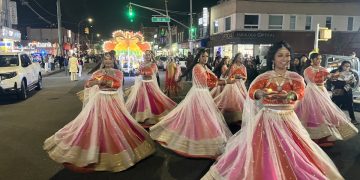
The emergence of Little Guyana (greater Richmond Hill where there is also Little Trinidad) society represented an important step in the organization of Guyanese cultural and social life although they initially faced prejudice, racism and push back from Italians and Irish who have been living there for decades. As Italian, Irish, and German populations shifted out of neighborhoods in Queens, Indo-Guyanese and Indo-Caribbean families established a deep-rooted enclave along Liberty Avenue and surrounding streets in Richmond Hill (that would be officially co-named Little Guyana, Little Trinidad, Little Punjab, etc.). But long before Richmond Hill, there was Jamaica, Queens Village, Hollis, parts of Brooklyn and Bronx where Guyanese experienced somewhat less prejudice and racism than in Richmond Hill and Ozone Park and environs. Wherever they clustered, they worked to preserve traditions such as Guyanese-style curry, roti, other cuisine celebrating festivals like Phagwah, Diwali, Eid. Guyanese residing in these various clusters encouraged solidarity among fellow Indian Caribbean immigrants while also preserving traditions connected to their culture such as music, dance, religious and social life, and various forms of entertainment (clubs, concerts). They formed countless organizations, some registered as non-profits and others not registered but organizing social and cultural activities. Over time, they also formed political clubs aligned with the democratic or republic Party. Through community events, fundraising campaigns, joining election campaigns, public celebrations of festivals, and organizations, Guyanese gradually from the 1990s began to establish influential institutions within American urban culture.