


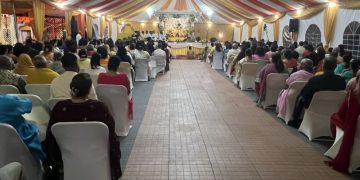

Indian Arrival Day is similar to Pitri Paksh – an expression of thanks to our forebears for their strength, courage and determination to overcome the many challenges and obstacles in their journey.
The Indian community, from its first day of setting foot on this land, was confronted with protests and scorn. We were viewed as a people who were willing to toil for meager wages to the disadvantage of the ex-slaves who were demanding high wages; also, our language, food, dress and religion were viewed as alien to a society where Christian values were entrenched. Under those challenging circumstances the Indians had to struggle to keep their heads above the water.
As we look back at the181 years of our history in this land, we must acknowledge those who toiled and struggled against the hostile forces for us to have a place in the society today. Among them were Adrian Cola Rienzi, Doon Pandit, Bhadase Sagan Maraj, Simbhoonath Capildeo, Chanka Maharaj, Basdeo Panday and Sat Maharaj. In our village of Endeavour, the contributions made by many including Pandit Ravindranath Maharaj, Haripersad Harikissoon and Krishna Lutchman must also be acknowledged.
In 1946 when Universal Adult Suffrage was debated in the parliament, a section of the society held the view that Indians should be denied the right to vote because they could not read and write in English. It was in this scenario that Adrian Cola Rienzi rose to the challenge. He mobilized mass meetings across the country and made representations before the parliament and the governor to have this proposal retracted. Thanks to this united resistance, this unjust proposal was withdrawn and Indian community won the right to vote.
The passage of the Hindu Marriage Act of 1945 was another landmark in the struggles of the Hindu community for social justice. Prior to the passage of the act, Hindu marriages were deemed illegal. Several children born of such marriages had no legal claims to the properties of their parents. The properties of hundreds of Hindu families were confiscated by State officials and redistributed among themselves.
Prior to the passage of the Hindu Cremation Act of 1953 Hindus had to bury their dead. The first cremation conducted in Trinidad was done at the dump in Port of Spain after a special permit was issued. It was only after strong representation and lobbying that cremation was made legal with the passage of the Hindu Cremation Act of 1953. One individual who fought for this right was Chanka Maharaj who was then a sitting member of Parliament.
Another area that Hindus have come to take for granted is education. In 1950 the illiteracy rate in the Indian community was 48.5 % and 60% in the Hindu community. Thanks to the efforts of Bhadase Maraj, Simbhoonath Capildeo, Pandit Teeluckdharry, Doon Pandit, Ajodhasingh, to name a few, the Maha Sabha school building program was launched in 1952. Today the Maha Sabha boasts of more than 50 schools at the kindergarten, primary and secondary levels.
As we celebrate Indian Arrival eating our sahina and polorie we must reflect on the contributions of Basdeo Panday. He made representation through the sugar union for better wages and improved working conditions for sugar workers. Prior to 1975 sugar workers had employment only during the harvesting or crop time- January to May- June. For the other six months sugar workers lived on credit from the local shop keepers. Most sugar workers lived in squalor and poverty, cooking with fire wood, using outdoor latrines with no running water and electricity. The struggles of Basdeo Panday to improve the lives of sugar workers also resulted in more of their children moving on to secondary schools and tertiary level educational institutions including The UWI.
More importantly, Basdeo Panday provided us with political stability and taught us how to win political power. If today the UNC is in power it is in no small way because of the foundational work done by Basdeo Panday.
In more recent times, the late Secretary General of the Maha Sabha, took the State to court challenging the Trinity Cross as the highest award of the land. As you are aware, Pandit Krishna Maharaj, former Dharmacharya of the Maha Sabha, had refused the Trinity Cross on the ground that it was a Christian symbol and not reflective of the religious plurality of the society. The matter went as far as the Privy Council in London and the Law Lords ruled against the State and also instructed the government to create an award that would be more representative of the religious and cultural diversity of the society. This finally evolved into the Order of Trinity of the Republic of Trinidad and Tobago.
Indian Arrival Day is a celebration of our survival and triumph. Our ancestors did not bury their heads in the sand and pretend that their problems would disappear but worked together to eliminate them. A few problems in our community that need addressing include the following: conversion, family challenges, health issues such as diabetes, high blood pressure, strokes, heart and kidney diseases and alcoholism. These problems are not insurmountable to overcome. However, if we can first acknowledge them, it would be easy to devise strategies to manage them.
While some families have made valiant efforts to educate themselves and become professionals and skilled in various technologies, there are families that remain backward. Such families must be reached and invited to be part of the mainstream community.
Our community is better off today than 100, 50 or 20 years ago in tackling these problems. The question that must be asked: Since we now have more education, better jobs and more money, why do we continue to feel lost and dejected? The simple answer is that our inputs in making policies and decisions are limited. And why are we not there? It is only because we allow our narrow self-interest to override the welfare of the wider community.
Without a doubt, Indians are an intelligent people, capable of organizing our individual and family interests. However, our high IQ has a strong shadow (ego/abhimaan) that eclipses our emotional intelligence. The challenge for us is to work in large groups. Politics and business at the corporate levels mean working with others to make decisions, not the one-man sole trader mentality. Consensus building and negotiation are necessary for success!
We all mourn the disaster that befallen the Hindu Credit Union. Subsequently, another credit union surfaced in the Barrackpore district but had to shut down after less that three years. Working in groups is our major challenge. It is the demand of the modern world. Victory or failure in a democratic framework entails numbers – the largest group wins.
If today your mandir continues to strive it is mainly because your Baba, Pandit Robin, did not have a doctorate but knew how to build -big up- people. I think that our success or failure as a people would heavily depend on how well or badly, we manage people. It is this rare skill that will help us to overcome challenges. I think our ancestors had those qualities that assisted in bringing us thus far. We must continue this journey, not in circles but ahead.
Happy Indian Arrival Day to You and Your Family.