





































It is often observed that Vedantic and philosophical Hinduism appears more visible and accessible in America than in Trinidad, despite the fact that Trinidad’s Hindu population descends directly from immigrants who came from India. This apparent contradiction can be understood by examining the different historical, social, and spiritual forces that shaped Hinduism in both societies.
The Indians who arrived in Trinidad during the indentureship period between 1845 and 1917 came primarily from rural communities in North India. They brought with them a living religious culture rooted in devotion, ritual, family traditions, folk practices, and sacred storytelling. Their challenge was not the advancement of philosophical discourse but the preservation of identity under difficult conditions. They were separated from India, faced economic hardship, and existed within a colonial society that often viewed their customs as foreign and inferior.
In such circumstances, the survival of Hinduism itself became the priority. Temples were built, festivals were maintained, the Ramayana was recited, and rituals surrounding birth, marriage, and death were preserved. The pandits who emerged within this environment served a vital function. They acted as custodians of culture, transmitters of memory, and guardians of religious continuity. Without their efforts, much of the Indo-Trinidadian religious heritage might have disappeared.
However, preservation and philosophical development are not always the same undertaking. The classical traditions of Vedanta demand rigorous study of the Upanishads, Brahma Sutras, Bhagavad Gita, Sanskrit grammar, logic, and contemplative disciplines. Such training was historically available only through established centers of learning and long-term teacher-student relationships. The indentured communities of the Caribbean possessed few of these institutional resources.
As a result, religious life often centered on ritual observance and scriptural narration rather than systematic inquiry into questions such as the nature of consciousness, the meaning of liberation, the relationship between the individual self and ultimate reality, or the non-dual teachings of Advaita Vedanta. Sacred stories were preserved, but their deeper philosophical symbolism was not always emphasized.
America’s encounter with Hinduism followed a very different path.
When Hinduism entered the American consciousness in the late nineteenth and twentieth centuries, it often arrived through some of the most intellectually sophisticated teachers India had produced. Rather than inheriting Hinduism through family tradition, many Americans encountered it through direct exposure to renowned gurus, swamis, and spiritual masters whose primary focus was philosophy, meditation, self-realization, and universal spiritual principles.
This distinction is significant.
Many Americans did not first encounter Hinduism through temple rituals or cultural customs. They encountered it through lectures on consciousness, books on meditation, retreats on self-inquiry, and discussions of the Upanishads. In many cases, they were introduced to the highest philosophical teachings before they ever learned the details of ritual practice.
The influence of modern gurus played a central role in this development.
Swami Vivekananda presented Vedanta to the West as a universal philosophy capable of speaking to modern science, psychology, and human reason. He emphasized the divinity of the soul, the unity of existence, and the possibility of direct spiritual realization. For many Western seekers, this was their first introduction to Hindu thought.
Paramahansa Yogananda introduced millions to meditation and the inner dimensions of spirituality. His teachings focused less on ritual observance and more on personal transformation through direct experience. Through his writings and institutions, many Western students encountered Hindu spirituality as a practical path of self-realization.
Later teachers continued this trend. Maharishi Mahesh Yogi popularized meditation on an unprecedented scale. Swami Chinmayananda established systematic Vedanta study programs that encouraged intellectual inquiry into scripture. Swami Dayananda Saraswati emphasized rigorous textual analysis and traditional Vedantic methodology. Ramana Maharshi’s teachings on self-inquiry inspired generations of seekers interested in the direct investigation of consciousness.
Beyond these figures, the twentieth century witnessed an extraordinary transmission of Indian spirituality into the Western world. Teachings from Yoga, Advaita, Tantra, Kashmir Shaivism, and Buddhist traditions became accessible through books, lectures, retreats, and eventually digital media. A sincere seeker in America could study advanced philosophical teachings from multiple traditions without belonging to a particular ethnic community.
This created an unusual situation in which a non-Hindu American could have extensive exposure to Vedantic philosophy while a person born into a Hindu family elsewhere might receive primarily ritual instruction.
The rise of modern communication accelerated this process further.
Today, seekers can access lectures from scholars, monks, and gurus from around the world. Thousands of hours of teachings on the Upanishads, Bhagavad Gita, Advaita Vedanta, Yoga, and meditation are available online. The modern spiritual landscape has become increasingly global. A student in New York, London, Sydney, or San Francisco may spend years studying Vedanta from teachers in India without ever visiting a traditional ashram.
At the same time, Trinidadian Hinduism has also begun to evolve. Greater access to books, international teachers, digital resources, and global networks has made philosophical study increasingly available. Younger generations are often seeking not only ritual participation but also deeper explanations of symbolism, metaphysics, and spiritual practice. Questions that were once rarely explored publicly are now discussed openly.
Yet it remains important not to reduce the comparison to a simple contrast between “ritual” and “philosophy.” Such a distinction can be misleading.
Traditional Hindu thought generally views devotion (bhakti), selfless action (karma), meditation (dhyana), and knowledge (jnana) as complementary dimensions of spiritual life. Rituals were never intended to be mere external performances. Properly understood, they serve as symbolic and psychological tools designed to orient the mind toward higher truths. Likewise, philosophical knowledge was never intended to become detached intellectual speculation. Its purpose was transformation and realization.
In this sense, both traditions possess strengths that the other can learn from.
Trinidadian Hinduism demonstrates the power of continuity, devotion, family transmission, and communal identity. It preserved a living tradition through generations of adversity. American Vedantic culture demonstrates the value of inquiry, philosophical openness, and direct engagement with questions of consciousness and self-realization.
The future may lie not in choosing one emphasis over the other, but in integrating both. A mature Hindu spirituality can preserve the richness of ritual and tradition while also embracing the profound insights of Vedanta. It can honor the devotional heart of religion while encouraging intellectual inquiry and direct spiritual experience.
Seen in this light, the history of Hinduism in Trinidad and America is not a story of one community succeeding where another failed. Rather, it is the story of a single tradition expressing different aspects of itself under different historical conditions. One preserved the flame; the other explored its light. Both contributions remain valuable, and together they offer a more complete picture of Hinduism’s ongoing evolution in the modern world.
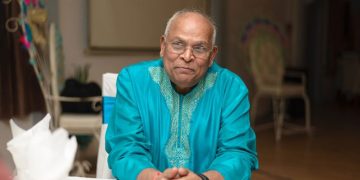
By Swami Avatar Samaroo