




















































India celebrates its 79th anniversary since it gained independence on August 15, 1947. At independence, the country had been scarred by religious partition which caused displacement of millions, deaths of thousands, and immense human suffering. The new nation was severely underdeveloped and impoverished with over 50% unemployment, mass hunger, and virtually no growth. There was limited infrastructure (roads, bridges, rails, airports, airlines, aircrafts) and virtually no air force, marine, navy. The army was severely weak, losing over a million soldiers fighting to save Britain and the allied forces in WWII from axis defeat. There were also terrible social and economic indicators and very poor health services and widespread illiteracy. The country was also faced with food shortages and a fragile industrial base. The new leadership did not lose hope. From the difficult conditions it inherited, the country embarked on one of the most remarkable journeys of nation-building in history.
Today, India is one of the world’s largest economies. It is also a major centre of information technology, the largest for outsourcing. It is the world’s largest producer of pharmaceuticals, a nuclear and space power, and a leading producer of food grains and so many items. India supplies skilled labor (tech) to most of the world. Its journey to progress has not been without setbacks, but the transformation since 1947 is undeniable.
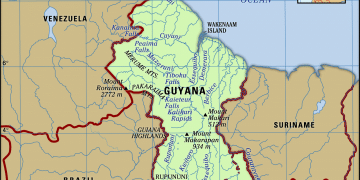
One of India’s greatest achievements has been the continuation of a democratic political system it inherited. Rights are guaranteed. While many newly independent countries around the globe struggled to establish stable democratic institutions and actually became dictatorships, including in Guyana, India conducted regular free and fair elections and experienced peaceful transfers of political power.
In the early years after independence, India faced serious food insecurity. Agricultural productivity was low, irrigation was inadequate and the country depended heavily on food imports. The Green Revolution of the 1960s changed the situation. High-yielding varieties of seeds, irrigation, fertilisers, agricultural research and improved farming techniques dramatically increased the production of wheat and rice. India has become an agricultural powerhouse, one of the world’s largest producers of rice, wheat, milk, fruits and vegetables. Guyana also used the green revolution and assistance from India to increase food production. Today, India is self-sufficient in food production as is Guyana.
The country also invested a lot in heavy industry, steel, power, machineries, transport, irrigation and public-sector enterprises. These investments created an industrial and infrastructural base that would later support faster growth. The economy had become stunted for a period of time. During the 1990s, liberalization and privatisation were introduced, resulting in foreign investment. The results were particularly visible in services. Information technology, telecommunications, financial services, pharmaceuticals, automobile manufacturing and business-process services grew rapidly. India rose from a relatively marginal position in the global economy to one of the world’s major economic powers. There emerged greater integration with the world economy, opening up new opportunities for Indian businesses. Indian engineers, programmers, doctors, nurses, scientists and entrepreneurs have made their mark internationally. And Indian investors have invested hundreds of billions of American dollars in many economies.
Up until the 1990s, the US and West refused to provide India with computer technology or to sell its super computer for research purposes. India government charged researchers to build their own. Today, India has advanced computing and communications infrastructure. Indian IT companies provide software, consulting, financial technology and digital services to customers around the world. In addition, India launches satellites of western countries to outer space.
The digital revolution has also transformed ordinary life for Indians. Mobile phones and inexpensive internet connectivity have expanded access to information, communication, banking, education and government services. Digital payments have become part of everyday economic activity. India has also advanced in defence technology and space science. India’s space programme has developed satellites, launch vehicles and sophisticated scientific missions, often while working with limited resources compared with other space advanced nations.
Life expectancy in India was only low 32 in 1947. Today, it is 75. Education has undergone a similarly dramatic expansion. At independence, literacy was only 18%. Today, it is over 80%. Every child has access to education. India possesses a vast network of schools, colleges, universities and professional institutions. Poverty has declined to 2.3%. The pharmaceutical industry has also become globally significant, particularly in the production of generic medicines and vaccines.
India’s physical landscape has changed dramatically since 1947. The country has expanded its road and railway networks, built dams and power plants, modernised ports and airports, and increased access to electricity and telecommunications. Urban India has expanded rapidly, with new business districts, metro systems, highways and residential areas reshaping major cities. Rural India has also experienced major changes. Electrification, roads, mobile connectivity, banking access, sanitation and improved transportation have brought many villages closer to the wider economy.
India’s economic and strategic importance has expanded considerably. India participates actively in major international forums and maintains relationships with countries across Asia, Europe, Africa and the Americas. Its growing economy, large market, technological capabilities, military strength and diplomatic influence have given it a more prominent role in global affairs. It is invited to major western forums including the G7. It is a member of the G20, using it to highlight issues concerning developing countries and the Global South. The story of India’s progress should not become a story of complacency. It must continue its progress towards a developed state.
The India of 1947 was struggling to overcome exploitation, poverty, illiteracy, food insecurity and the legacy of colonial rule. The India of today possesses enormous human talent, a large and diversified economy, sophisticated scientific institutions, a powerful technology sector and a growing voice in world affairs. The transformation has been built over generations. Farmers contributed to food security; scientists and engineers have built India’s technological capabilities; entrepreneurs created businesses and jobs; teachers expanded education; workers have built infrastructure; and citizens have sustained the world’s largest democracy. India’s journey since independence is therefore not merely a story of economic growth. It is a story of nation-building, resilience and aspiration. The challenge is further growing its economy and uniting a diverse nation.
From the difficult circumstances of 1947 to the opportunities of today, India’s journey has been extraordinary. The achievements are substantial, but the journey is unfinished. There is need for more tech-driven employment, better quality of education, affordable healthcare, greater women’s participation in the workforce and in business, raising agricultural productivity to guarantee food security, and reducing inequality.