


















































By Dr. Ramesh Gampat and Minakshi Mahabir
September 2026
Guyana is in the midst of one of the most dramatic economic transformations in recent history. Since oil exports began in 2019, the economy has grown at extraordinary speed — by 2026, overall GDP was approximately 7.5 times its 2019 level, making Guyana one of the fastest-growing economies on earth. Public spending on health and education has expanded in tandem: the health budget grew nearly eightfold between 2014 and 2026, and spending per capita on health and education together rose by nearly 585 per cent over the same period. A country can grow rich without growing capable. Guyana, as we document below, is doing exactly that.
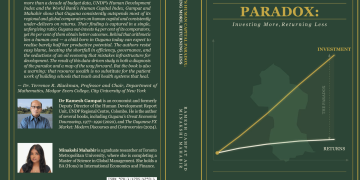
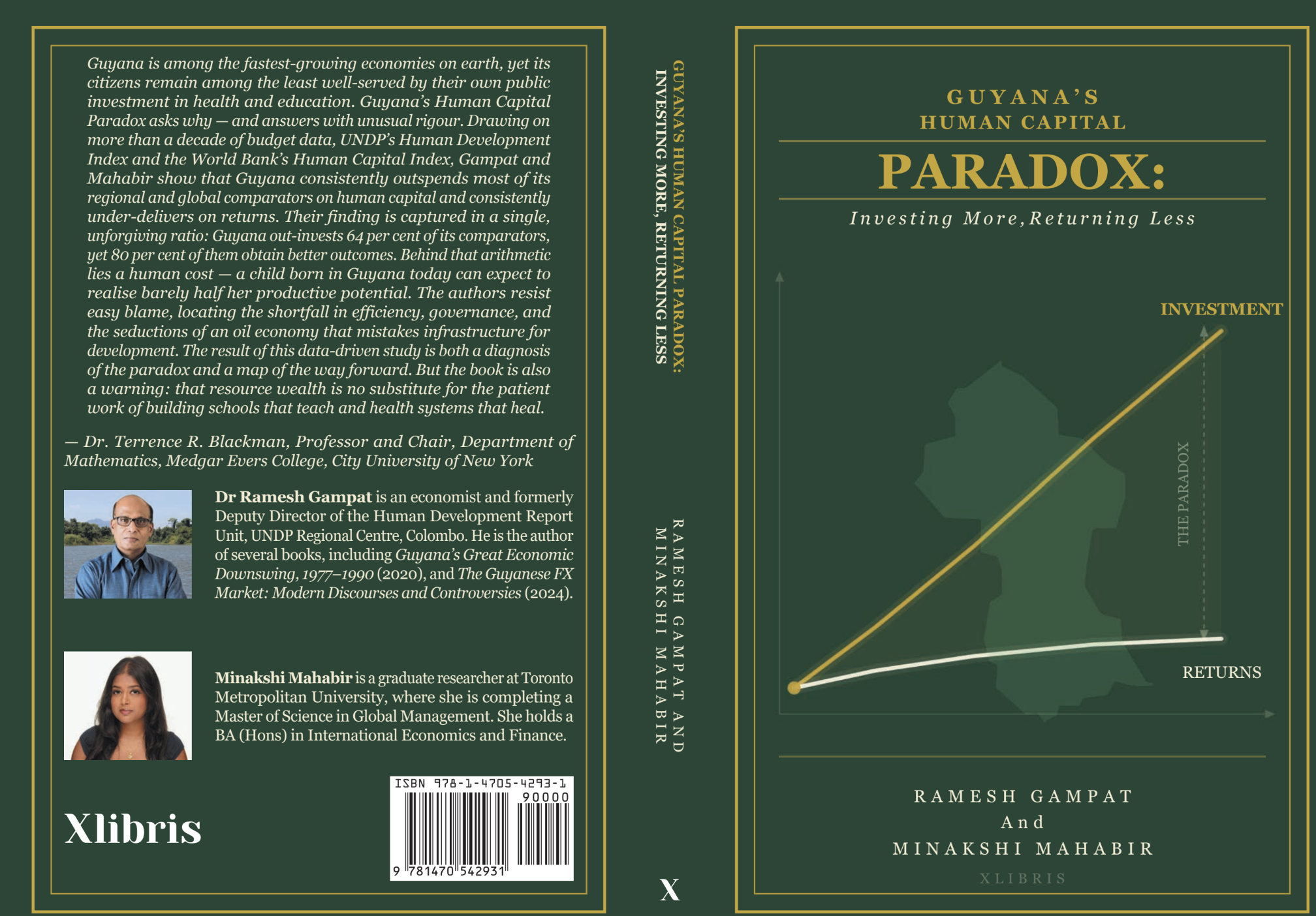
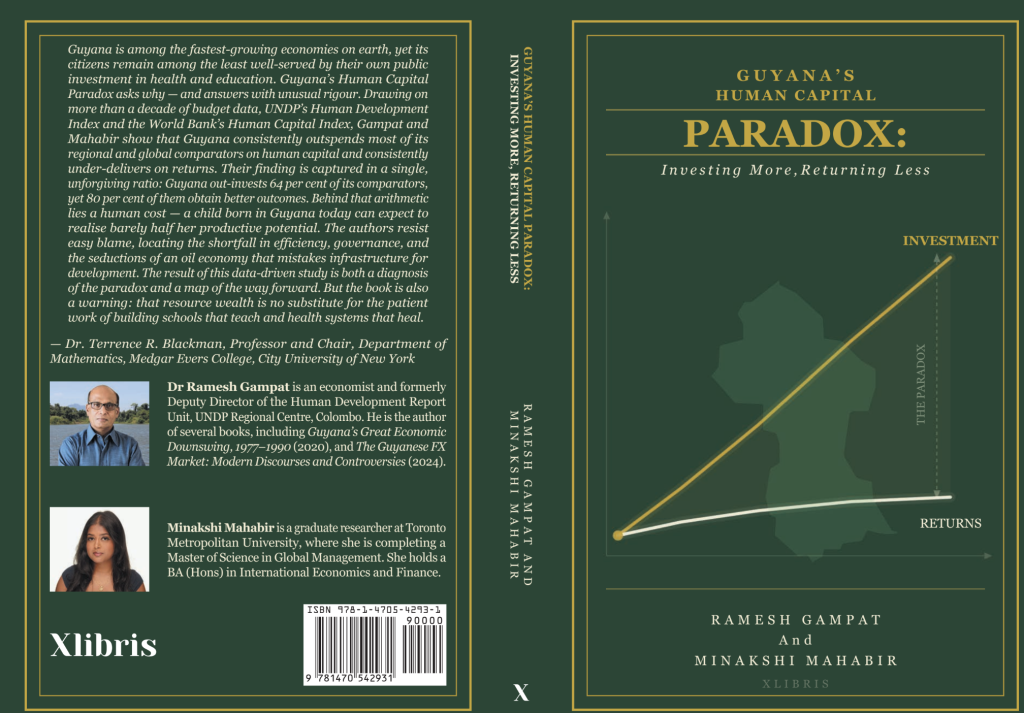
In our recently published book, Guyana’s Human Capital Paradox: Investing More, Returning Less, we document a striking and persistent gap between what Guyana spends on its people and what its people receive in return. The numbers tell a story that official optimism works hard to obscure.
Our analysis covers 18 comparator countries — nations drawn from Latin America, the Caribbean, and the wider developing world that are broadly comparable to Guyana in terms of income, institutional development, or geographic context. Across this sample, we find that Guyana out-invests 64 per cent of its comparators in health and education as a share of GDP and of total central government expenditure. Yet 80 per cent of those same comparators obtain better outcomes — as measured by the health and education indices of the Human Development Index (HDI) and the Human Capital Index (HCI).
Guyana’s HDI score of 0.776 (2023) places it well below its Caribbean neighbours. Its income index is effectively at its ceiling: with a per capita income that now exceeds most peer countries, further income growth adds little to the HDI. Improvement therefore depends entirely on health and education outcomes — and this is precisely where Guyana falls short. Life expectancy is lower than in all 74 countries with very high human development. Put simply, no country in our comparator group converts its per capita income into human development so poorly. In this dubious distinction, Guyana stands alone.
The Human Capital Index (HCI) paints a similarly sobering picture. Guyana’s HCI score of 0.495 means that a child born in the country today can expect to realise barely half her productive potential by the time she reaches the age of 18. The Learning-adjusted Years of School (LAYS) and the Harmonised Test Score (HTS) — two of the HCI’s most important components — are both substantially below the comparator mean. In plain terms: Guyanese children are spending years in school but learning less than their peers in countries that invest smaller shares of their national resources in education.
 Why? We identify three mutually reinforcing explanations. First, efficiency: the link between spending and outcomes in health and education is weak, suggesting that significant sums are lost to administrative overhead, procurement irregularities, and poor institutional design. Second, inequality: the benefits of public investment are not distributed evenly, and Guyana’s high level of income inequality — a Gini coefficient of 52.0 — means that improvements in average outcomes mask wide disparities between communities, particularly between coastal urban areas and the interior regions. Third, governance: Guyana’s Corruption Perception Index score of 38 out of 100 points to a political environment in which resources earmarked for human development are vulnerable to diversion. The question is not whether Guyana can afford to fix its schools and clinics — at current revenue levels, the answer is unambiguously yes. The question is whether it can afford to keep pretending that nothing is broken.
These findings point to a set of policy priorities that are neither complicated nor expensive relative to Guyana’s current fiscal capacity. But they are politically demanding — because they require acknowledging that the problem is not how much Guyana spends, but how it spends.
Before Guyana decides to spend even more on health and education, it needs to understand why current spending is not working. A comprehensive national stocktaking — assessing the state of health and functional literacy in each of the country’s ten administrative regions — would identify where the system is failing and for whom. That evidence base should underpin a ten-year human capital strategic plan, with clear and measurable targets, regional disaggregation, and independent monitoring. Other Caribbean nations — Barbados, Jamaica, Trinidad and Tobago — have benefited from such frameworks. Guyana currently lacks one.
The most urgent education priority is learning quality, not enrolment or time in school. Guyana’s harmonised test scores — a direct measure of what children actually learn — are among the lowest in our comparator sample, nearly 15 per cent below the group average. A sustained programme of teacher training and incentive reform, combined with the expansion of technical and vocational education pathways aligned to the labour market, would address both the learning deficit and the country’s high rates of youth not in employment, education, or training — currently around 46 per cent of young people aged 15 to 24. Taiwan’s deliberate investment in technical and vocational colleges in the 1960s and 1970s, which channelled school-leavers into industry-aligned programmes, transformed a developing country into an innovation powerhouse within a generation. Guyana’s oil economy presents a comparable opportunity — but only if the investment is made now, while the demographic window is open.
In health, the most consequential gap is geographic. The share of the health budget allocated to Guyana’s ten administrative regions — where the country’s most vulnerable populations, including indigenous Amerindian communities, are concentrated — has declined sharply in recent years, even as the overall health budget expanded. Reversing this trend, and rebuilding a genuinely national primary health care system, would do more to improve life expectancy and adult survival rates than any further expansion of tertiary facilities in Georgetown. Sri Lanka, with a per capita income roughly 23 per cent below Guyana’s, achieved an adult survival rate of 90 per cent against Guyana’s 77 per cent, largely through decades of investment in primary care and equity of access. The lesson is not more spending, but better targeting.
Finally — and most fundamentally — improvement in human capital outcomes requires that public institutions be held accountable for results, not merely for expenditure. High spending on education that leaves children unable to read is not investment; it is waste with good intentions. Independent auditing of health and education spending, with findings reported publicly and linked to consequences for public officials, is a minimum condition for closing the gap between budget and delivery. The President’s 2025 pledge to establish an Anti-Corruption Unit is a step in the right direction; its mandate should explicitly encompass the social sectors, where procurement volumes are large and oversight has historically been weak.
The lessons for regional policymakers extend beyond Guyana. Oil wealth creates fiscal space; it does not automatically create human capital. The Caribbean nations that have built strong human development — Barbados, with an HDI of 0.811, and Trinidad and Tobago, with 0.807 — have done so through sustained investment in education quality and health system capacity, combined with institutions capable of holding governments accountable for results. Resource wealth without institutional quality produces the paradox we document in Guyana: a country growing richer and developing more slowly than its resources would allow.
Guyana has the resources that most developing countries can only dream of. With 64 per cent of its population of working age and a median age of just 27 years, it also has a demographic window that will not remain open for ever. The East Asian economies that transformed themselves in the second half of the twentieth century did not do so by spending more than their peers; they did so by spending smarter, aligning human capital investment with economic need, and building the governance institutions to sustain that alignment over time. Guyana’s moment is now. The arithmetic of the 64/80 paradox is not destiny — but closing it will require something that oil revenues alone cannot buy: the honesty to acknowledge what is broken, and the political courage to fix it.